
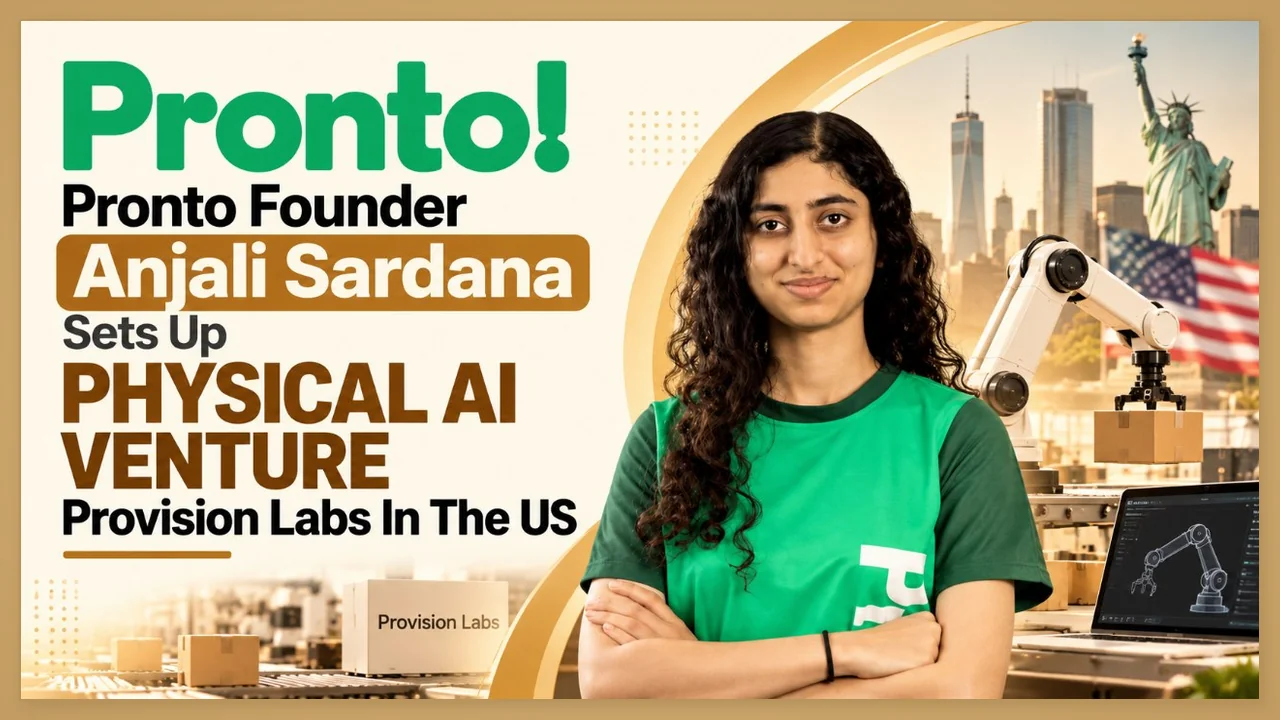
Anjali Sardana, founder of the instant household services startup Pronto, has set up a second company in the United States. The new venture, Provision Labs, will collect real-world data to train and test AI systems that operate robots and other machines, according to a report by the Economic Times.
Provision Labs will work with developers building models for robotics and other physical applications. Its website lists Lachy Groom, Glade Brook, General Catalyst and Bain Capital Ventures as backers. All four are also investors in Pronto.
Read More: How 23-Year-Old Anjali Sardana Built Pronto Into A Rs 2,000 Crore Home-Help Startup
Read More: Ex-ISRO Scientist’s Deeptech Startup SpectraGaze Raises Rs 3.7 Cr Led By GVFL
What Provision Labs Will Do
Most AI systems are trained on text and images scraped from the internet. Robots need something different. They need footage and sensor data from real rooms, with real furniture, real clutter and real hands doing the work.
Provision Labs is positioning itself as the supplier of that material. Its focus is on collecting data that developers use to train models and, more importantly, to test them against conditions their own labs cannot reproduce.
The distinction matters commercially. Training data can be licensed once. Testing environments have to be refreshed continuously, because every new robot model fails in ways the previous one did not.
Why a Services Founder Is Selling Data
Pronto was founded in 2025 and connects households with trained, background-verified professionals for cleaning, laundry, utensil washing, meal preparation, car washing and gardening. It is a services business with people inside homes every day.
That access is the asset. In July 2026, Pronto confirmed it was continuing and expanding a programme called Pronto Verified, an opt-in service that records service sessions and uses anonymised footage for AI training.
Seen from that angle, Provision Labs is not a pivot. It is the same operation, packaged for a different buyer. Household services generate the footage. The US venture sells the resulting data and testing capacity to robotics developers who have money and no way to film thousands of Indian and American homes.
The Camera Question
The obvious risk is consent. A person who books a cleaning service is not thinking about being filmed for a robotics dataset, even if the terms mention it.
Pronto’s answer is that the service is opt-in and the footage is anonymised. That is a reasonable position and still a fragile one. Anonymisation is a technical claim that has to survive audits, and any leak in a home setting is a reputational event that no terms of service can undo.
This is also where the US structure helps. A venture registered abroad can set data-handling rules and liability terms that differ from the consumer app’s, which is useful when the customers generating the data are in another country.
What It Means for Pronto’s Fundraising
Pronto extended its Series B to $45 million in May 2026, after a fresh $20 million from Lachy Groom. The round valued the company at $200 million, roughly double its valuation about a month earlier. Total funding stands at around $60 million.
A second company with the same cap table is a signal. Investors who already hold Pronto equity are funding the data layer separately, which lets them own the part of the business that could serve every robotics company rather than one services brand.
It also complicates the story the parent tells future investors. If the data business is where the margins sit, Pronto becomes the supplier of a proprietary advantage rather than a services company with an AI angle.
What to Watch
Three things will show whether Provision Labs is a real business or a structure with a website. The first is a named customer. Robotics developers are private about their data pipelines, but a paying contract disclosed in the next year would settle the question.
The second is volume. Home-service footage is useful only at scale, and the number of recorded sessions per month is the metric that decides whether the dataset is interesting to a lab.
The third is regulatory. India is still shaping rules on data collected inside homes, and a US venture drawing on footage from Indian households sits directly in that gap. How it handles that exposure will decide whether the model travels.