Morsa Raises $1.5 Mn For AI COO That Runs Factories Inside WhatsApp Groups

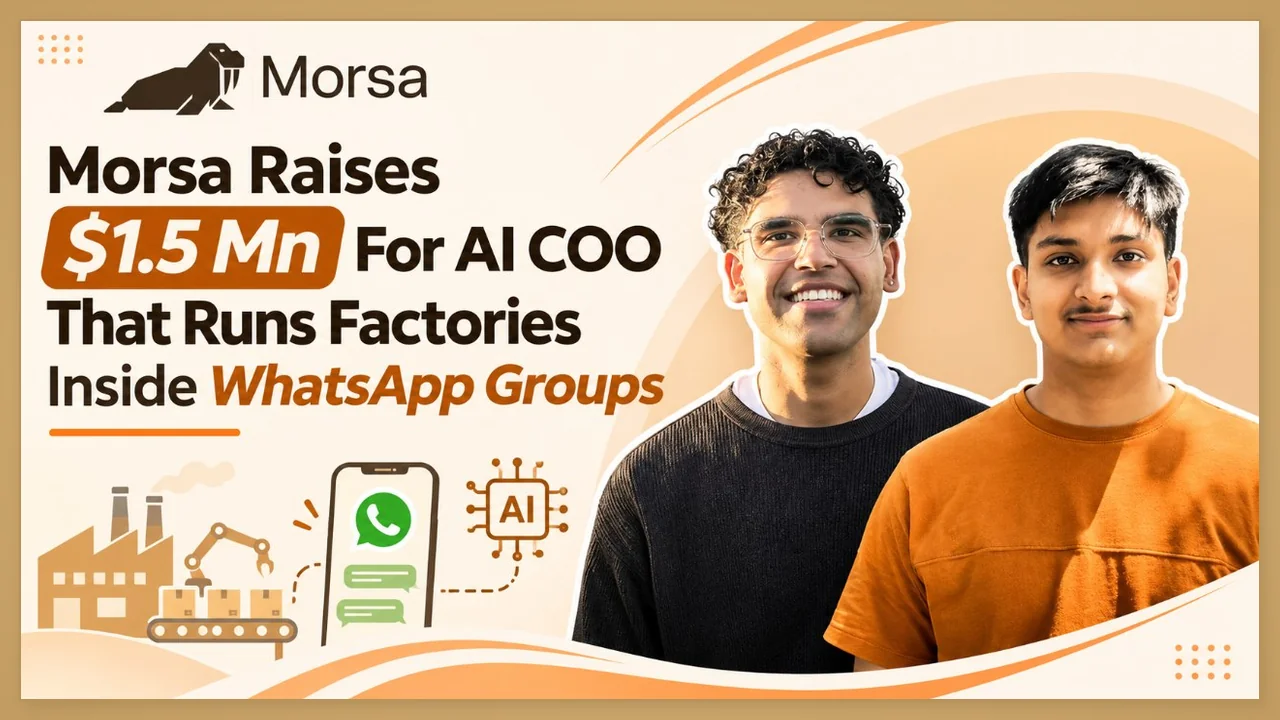
Morsa, a Delhi-based manufacturing AI startup, has raised $1.5 million in a pre-seed round led by Silicon Valley-based Jackson Square Ventures, with participation from the a16z Scout Fund.
The company. Operates under parent Lunar Inc., will use the money for product development and to scale deployments across manufacturing plants in India and the United States.
What an AI COO Does
Morsa’s software sits on top of the systems a factory already uses: enterprise resource planning, manufacturing execution systems, email and messaging groups.
Read More: Delhivery Signs Tata Motors, Euler And Montra To Deploy 2,000 Electric Vehicles


Instead of asking workers to learn a new dashboard, the platform reads operational data and shop-floor conversations. It then detects bottlenecks, assigns ownership of tasks, chases suppliers, re-plans schedules and checks whether work was actually completed.
Read More: Canonicus Capital Marks First Close Of Rs 500 Cr Fund At Rs 192 Cr
For Morsa, that is a deliberate design choice. Factory software usually fails because the people who need to update it are standing on a shop floor, not sitting at a screen.
The Pilot That Sells the Story
An early commercial deployment was at J4S, a glass manufacturing facility with 120 employees. Morsa was plugged into the plant’s existing ERP software and its operational WhatsApp groups.
Over four weeks, the system tracked about 900 operational commitments. The share of tasks completed on time rose from 30% to 75%, according to the company.
Morsa says it is now active across multiple plants, supporting 212 personnel across 75 operational group chats, including at a Tier 1 automotive supplier it did not name.
Why Messaging Beats Dashboards in Indian Factories
For Morsa, Indian manufacturing runs on WhatsApp. Purchase orders are confirmed there, machine breakdowns are reported there, and shift handovers happen there.
That makes the messaging layer the richest operational dataset in the plant. The one nobody can audit. A supervisor who says a job is done in a group chat leaves no record that a system can verify.
Morsa’s product turns those unstructured commitments into tracked tasks. The value is not the chat interface; it is the accountability layer underneath it.
The Founder’s Premise
“I grew up around my family’s factories and have worked across eight of them. The limit is never the machines. It’s how fast a plant can decide and act,” founder Kapoor said.
That framing sets the product’s scope. Morsa is not selling automation of machines. It is selling speed of decision-making, which is a management problem rather than a robotics one.
Indian manufacturing has thousands of mid-sized plants that run on ERP software installed years ago and never fully adopted. Those plants are the natural market for a layer that works on top of what exists.
The alternative, replacing the ERP, costs far more and takes a year. Morsa’s pitch depends on avoiding that project entirely.
WhatsApp also sets a hard boundary. Business API rules limit automation. A vendor that gets flagged for spam loses the channel it depends on.
There is also a data question. Tracking shop-floor commitments means reading employee messages, and plants will ask who owns that data and how long it is retained.
The product’s next step is likely pricing per line or per machine rather than per plant, which fits how factory budgets are actually approved.
What to Watch
Three things will decide whether this scales. The first is whether the 30% to 75% improvement holds beyond a single plant. Pilots are chosen to succeed.
The second is integration breadth. Every factory runs a different ERP, and each new system is a deployment cost.
The third is pricing. A per-plant subscription has to be cheaper than the supervisor time it replaces. That number changes with plant size.
Sudip Kumar is a Writer at Bharat Fast, contributing to the platform for more than six months. With an interest in startups, entrepreneurship, digital media and graphics designing, he enjoys exploring emerging businesses and sharing informative stories with readers.
More from this section

Pune Startup Froncort.AI Gets $2.3 Mn Google.org Grant For AI Disease Screening App
Sachin Tendulkar Backs Waste Management Startup Recykal
mistEO Raises Rs 18 Cr Seed Led By MGF-Kavachh For Climate Intelligence