Delhivery Signs Tata Motors, Euler And Montra To Deploy 2,000 Electric Vehicles

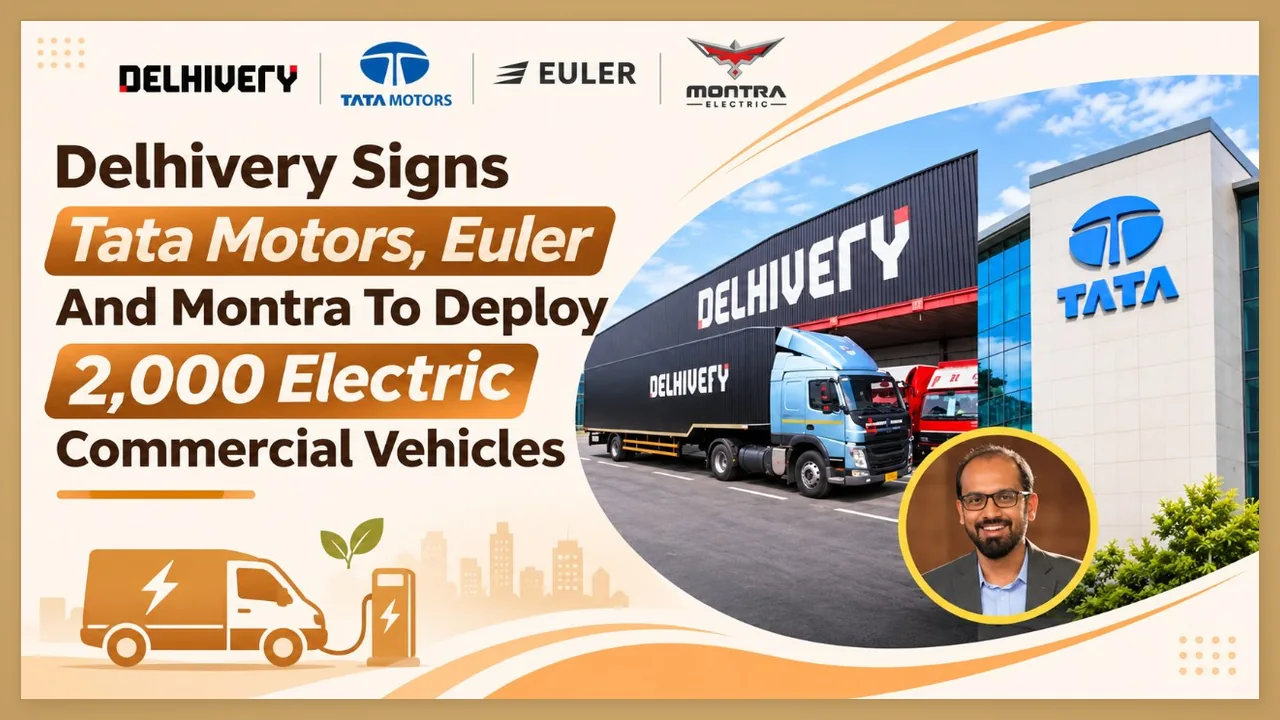
Delhivery has signed agreements with Tata Motors, Euler Motors and Montra Electric to deploy 1,500 to 2,000 four-wheeler electric commercial vehicles across its intra-city network over the next 12 to 18 months.
The move is the first step in a plan to put close to 5,000 electric commercial vehicles on the road over three years, with charging infrastructure pilots starting in Delhi-NCR.
Why Intra-City Is the Right Segment
Delhivery’s intra-city fleet covers vehicles that run less than 200 kilometres a day. That is the segment where electric vehicles now compete with diesel on total cost of ownership.
Read More: Canonicus Capital Marks First Close Of Rs 500 Cr Fund At Rs 192 Cr


Long-haul trucks remain a different problem. They need bigger batteries, highway charging and payloads that current electric platforms cannot carry economically.
Read More: Pune Startup Froncort.AI Gets $2.3 Mn Google.org Grant For AI Disease Screening App
Short urban routes are where the maths already works. The vehicle returns to a hub each night and can charge while idle.
Three Partners, Three Vehicle Classes
Each manufacturer brings a different vehicle class. Deployment starts with smaller vehicles suited to urban deliveries and later moves to higher-capacity models for routes that need larger payloads.
The Montra Electric tie-up is aimed at expanding deployments of the EVIATOR nationwide. Montra, part of the Chennai-based Murugappa Group, lists the EVIATOR with a payload of about 1.7 tonnes, a 10.3-foot loading deck and a certified range of 292 kilometres, with battery options from 32 kWh to 50 kWh.
For Delhivery, the range figure matters less than the payload and the deck length. Those determine how many parcels fit in one trip.
The Charging Problem
Prashant Gazipur, chief operating officer at Delhivery, said scaling fleet electrification means finding solutions that work across the diverse needs of the network without compromising operational efficiency.
He added that the charging facilities being piloted will make adoption easier and more affordable for vendor partners.
For Delhivery, that last point is the crux. Most of Delhivery’s last-mile fleet is not owned by Delhivery. It belongs to contractor partners who buy or lease their own vehicles. They switch to electric only if the total cost per delivery falls.
The Cost Angle
Electric cargo vehicles cost more upfront than diesel equivalents. The savings come from fuel and maintenance. For a delivery vehicle running 150 kilometres a day is substantial.
The financing gap is what usually blocks adoption. A vendor partner needs a loan for a vehicle that costs 40% more, against uncertain resale value.
That is why charging infrastructure and manufacturer partnerships arrive together. A vendor who can charge at a Delhivery hub and service the vehicle through the OEM has a clearer cost picture.
Delhivery’s own network handles millions of shipments a month. Intra-city legs are the most expensive part of the journey per kilometre.
Electrifying that leg also helps clients with their own emissions reporting. Is increasingly a condition in enterprise logistics contracts.
The competitive benchmark is not another logistics company. It is the internal delivery fleets of large ecommerce platforms. Have been electrifying their last mile for years.
Charging infrastructure will decide the pace. A hub that charges ten vehicles overnight needs a sanctioned load that most logistics parks do not have today.
What to Watch
Three numbers will show whether this works. The first is how many of the 1,500 to 2,000 vehicles actually hit the road. Memoranda of understanding often outnumber registrations.
The second is utilisation, meaning kilometres per vehicle per day, since an electric vehicle that sits idle loses its cost advantage.
The third is whether vendor partners renew. A second order from the same contractors would prove the economics worked, not just the announcement.
Sudip Kumar is a Writer at Bharat Fast, contributing to the platform for more than six months. With an interest in startups, entrepreneurship, digital media and graphics designing, he enjoys exploring emerging businesses and sharing informative stories with readers.
More from this section

Canonicus Capital Marks First Close Of Rs 500 Cr Fund At Rs 192 Cr

Cult.fit Faces Madras High Court Plea To Cancel CULT Trademark Over Alleged Forgery

Gaurav Munjal Steps Down As Unacademy CEO; Akhilendra Kumar Takes Over