
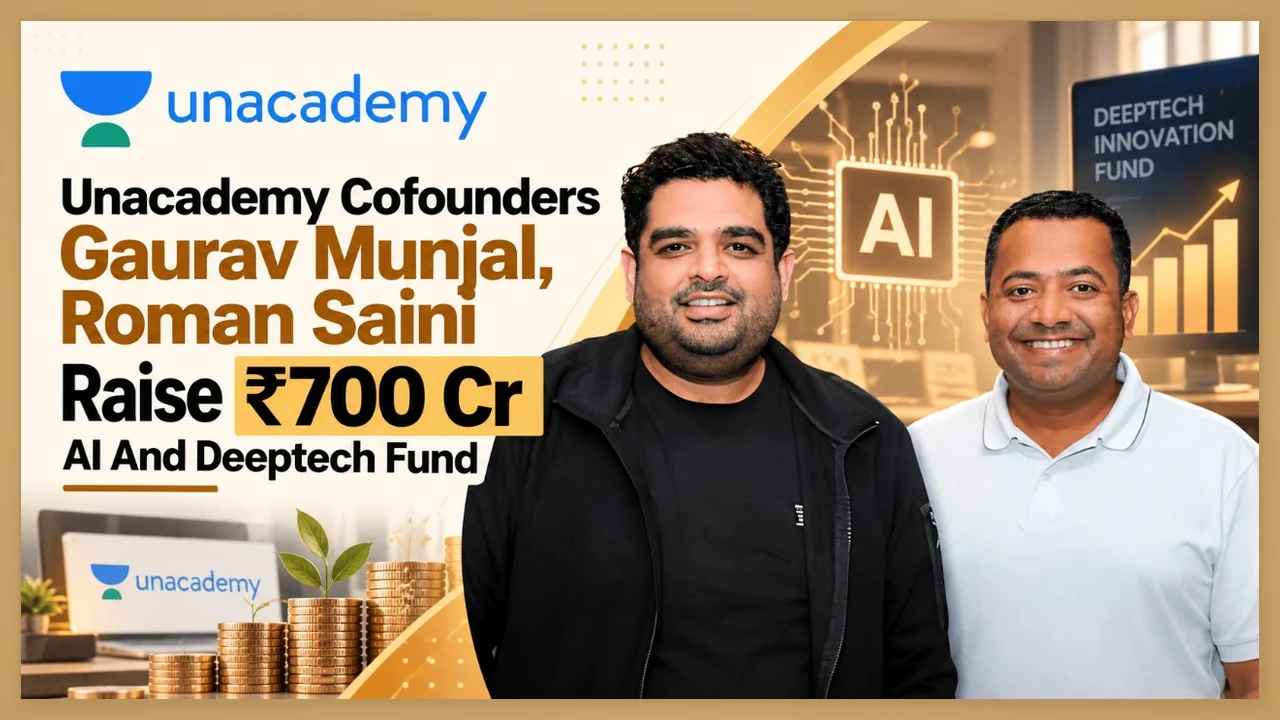
Unacademy cofounders Gaurav Munjal and Roman Saini are raising a Rs 700 crore venture capital fund to back AI and deeptech startups. The vehicle is called Longshot Capital and is registered as a Category II alternative investment fund.
Longshot Capital has commitments of around Rs 250 crore to Rs 300 crore and is targeting a first close in January 2027, according to a report by the Economic Times. Both founders declined to comment. The plan comes less than two months after upGrad completed its acquisition of Unacademy.
Read More: Pronto Founder Anjali Sardana Sets Up Physical AI Venture Provision Labs In The US
Read More: Indian Startup Funding This Week: 15 Startups Raise $133.9 Mn, Down 56%
What Longshot Capital Will Do
Longshot Capital plans to invest in 25 to 28 companies at the seed and pre-Series A stage. Initial cheques will run from $500,000 to $1.5 million, with a target ownership of 8% to 12% in each company.
The mandate is narrow by design. The fund will look at AI-led businesses and deeptech segments such as manufacturing, space, defence and robotics. Consumer brands and retail are explicitly out of scope.
It will invest in India-based startups and in companies founded by entrepreneurs of Indian origin, deploying capital over three years. The fund itself has a life of 10 to 11 years, which is longer than the standard Indian venture fund and reflects how slowly deeptech companies mature.
Why a Fund Makes Sense After the Unacademy Exit
Munjal and Saini have been writing angel cheques for more than a decade. Between them they have put over Rs 25 crore into more than 200 companies, including Pine Labs, Dhan, Ultrahuman, Snabbit, Swish, STAGE, Seekho and Third Wave Coffee. In August they invested in Superleap, an AI-native customer relationship platform.
That history is the pitch. A fund formalises what was already happening deal by deal, and it gives the two founders a way to keep deploying after the company they built was sold.
The timing also helps fundraising. Indian AI startups raised $438 million across 28 deals in the third quarter of 2026, up 265% year on year. Deeptech startups raised $290 million across 28 deals in the same period, up 176%. Limited partners are looking for managers with a thesis in both.
Cheque Size Versus the Market
A $500,000 to $1.5 million cheque at seed is a deliberate position for Longshot Capital. It is small enough to write 25 or more cheques from a Rs 700 crore corpus with reserves for follow-ons, and large enough to lead a round.
The trade-off is relevance. In AI infrastructure, seed rounds now close above $3 million in many cases, which means Longshot will often be a participant rather than the lead. Being the first institutional cheque into a deeptech company is the alternative, and that requires the fund to move faster than bigger rivals.
The 8% to 12% ownership target suggests the fund wants meaningful stakes without demanding board control at entry. For founders, that is a friendlier structure than a large fund taking 20% at seed.
Two General Partners, One Full-Time
Roman Saini will run Longshot Capital full-time. Munjal will be involved part-time alongside his role heading Unacademy, according to the report.
That split is common in founder-led funds, and it carries a specific risk. LPs tend to underwrite the full-time partner, and founders often want the better-known name in the room. If Munjal’s attention is elsewhere, the fund has to prove that its deal flow comes from the firm rather than from him.
The LP base reflects that tension. Prospective investors include startup founders, family offices and overseas institutions. Founder money is easier to raise for a founder-led fund. Institutional money will ask harder questions about who runs the portfolio.
What to Watch
Three things will show whether Longshot Capital becomes a serious deeptech manager or a founder’s angel syndicate with a licence. The first is the first close. Rs 700 crore is the target, and Indian AIFs routinely announce a target well above what they finally raise.
The second is the first three investments. If they cluster in AI software, the deeptech claim is marketing. If they include a robotics or space company with a long build cycle, the fund is doing what it says.
The third is follow-on capacity. Deeptech companies need several rounds before revenue, and a fund that cannot support its winners in the second round loses its best companies to larger investors. That, more than the cheque size, will decide what Longshot actually is.