Sarvam Launches Prism, A 44-Millisecond Decision Model On Sarvam 105B

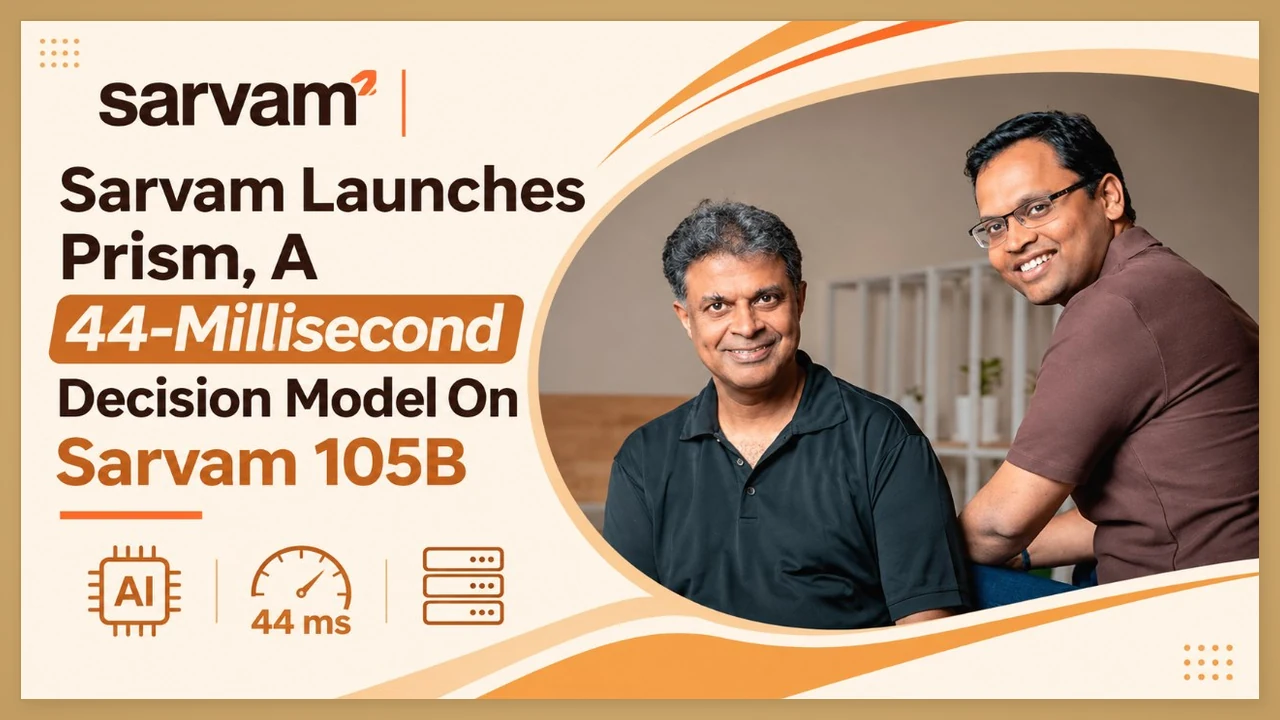
Sarvam has launched Prism, an AI model that picks from a fixed set of answers instead of writing text, and released its weights so enterprises can train and run it on their own infrastructure.
The Bengaluru-based startup calls Prism a “System One decision model”, built on its own 105-billion-parameter foundation model, Sarvam 105B.
The Number Sarvam Is Leading With
Sarvam says Prism scores 71.8 while responding in a median 44 milliseconds on a single Nvidia B200 GPU.
Read More: NPCI Sets Up NTSL For AI And Blockchain, Vishal Kanvaty Named CEO


The company says that makes it the highest-scoring model under 100 milliseconds across 25 models it tested, averaged over three indices.
Read More: altM Raises $10.3 Mn To Make Chemicals From Farm Waste
For Sarvam, speed at that level changes what a model can be used for. A two-second response is a chat feature. A sub-100 millisecond response is infrastructure. A 44-millisecond response can sit inside a transaction, a call or a workflow without the user noticing.
Why a Decision Model Is Different
The name is borrowed from behavioural psychology. System One thinking is fast and automatic, and that is exactly the behaviour Sarvam is engineering into a model.
Sarvam’s Prism sits apart from most language models, which generate text token by token, which is flexible and slow. A decision model chooses among predefined options, which is narrow and fast.
For Sarvam, that trade is deliberate. Plenty of enterprise tasks are classification problems dressed as conversations: route this complaint, flag this transaction, pick the right reply, tag this document.
For those tasks, generating a paragraph is wasted computation. Selecting from a fixed set removes the latency and makes the output auditable, because every answer maps to a known label.
Open Weights Change the Buyer
Releasing the weights means an enterprise can fine-tune Prism on its own data and run it on its own servers.
For regulated Indian companies, that solves the hardest procurement objection. A bank or insurer that cannot send customer data to an external API can still deploy a model it controls.
It also puts Sarvam in a different business from API providers. The company sells a model, not a subscription to a service it operates, and that changes who its competitors are.
The Infrastructure Behind It
Sarvam’s co-founders, Dr Vivek Raghavan and Dr Pratyush Kumar, have built the company around Indian-language coverage first and enterprise deployment second. A decision model fits that strategy because it is the part of AI that businesses actually buy.
Sarvam has been building physical capacity alongside its models. In July, HCLTech said it would set up its first AI data centre at the Odisha Sovereign AI Park in Bhubaneswar, in partnership with Sarvam and the Odisha government.
The planned capital outlay is Rs 14,257 crore, including financial assistance from the state.
That matters for a model company. Inference at 44 milliseconds requires guaranteed hardware, and hardware that sits in India removes both latency and compliance friction.
What to Watch
There is also a commercial question underneath the technical one. Open weights invite competitors to fine-tune on the same base and sell their own version, which caps how much Sarvam can charge for the model itself.
Three things will decide whether Prism becomes a standard. The first is independent verification of the 71.8 score and the latency claim, because vendor benchmarks rarely survive third-party testing unchanged.
The second is adoption by a large enterprise with a name attached. One public deployment inside a bank or a telecom operator is worth more than a leaderboard position.
The third is the fine-tuning story. Open weights only help if customers can actually train them, and that needs tooling, documentation and support that Indian model companies have historically under-invested in.
Sudip Kumar is a Writer at Bharat Fast, contributing to the platform for more than six months. With an interest in startups, entrepreneurship, digital media and graphics designing, he enjoys exploring emerging businesses and sharing informative stories with readers.