
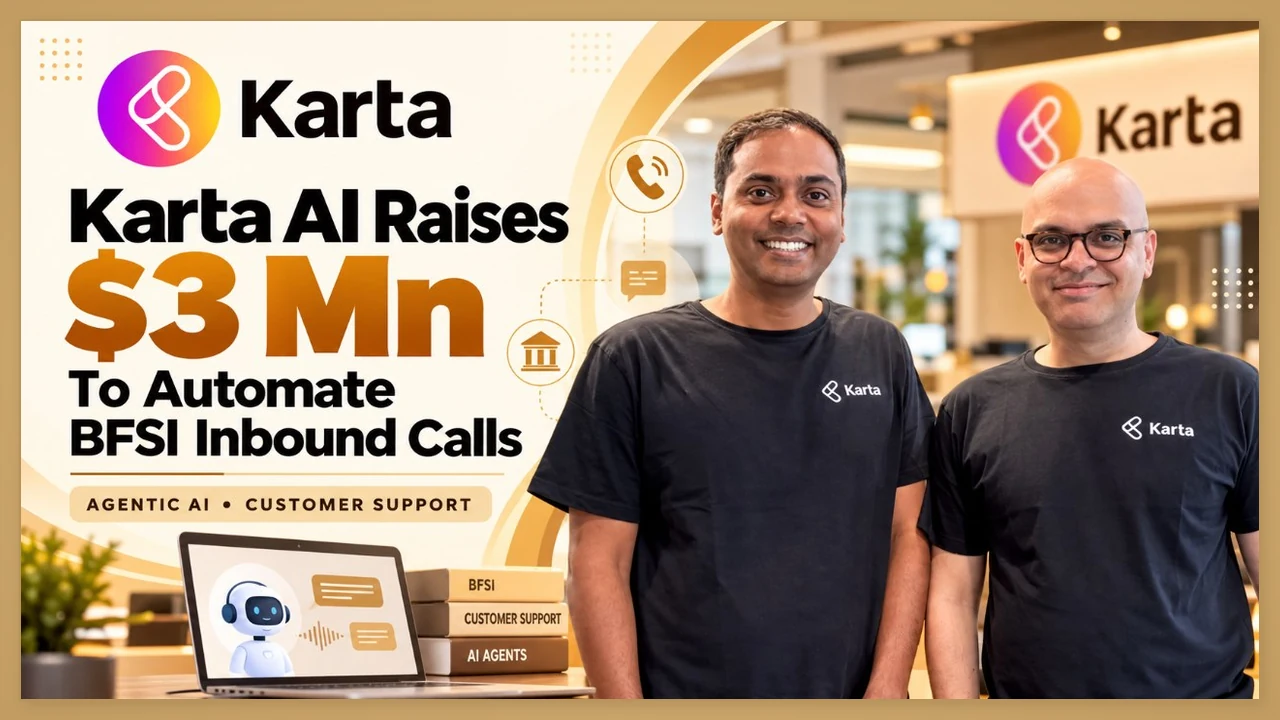
Karta AI has raised $3 million, about Rs 28 crore, in a seed round led by PeerCapital and Cedar Hill Capital. Wyser VC, CDM Capital and Seedstars also participated. The Bengaluru startup sells AI agents that answer customer calls for banks, lenders and insurers.
The money goes into go-to-market and distribution over the next two years. Part of it funds product work, including self-learning capabilities. Vijaypal Singh, cofounder and chief executive, said the company wants repeatable capabilities for financial services before it looks at overseas markets.
Read More: Enterprise AI Startup AuxoAI Raises $20.7 Mn Series A Led By NTTVC
Read More: AI Hiring Startup Hunar.AI Raises Rs 39.3 Cr Led By Blume Ventures
What Karta AI Sells
Karta AI runs an omnichannel customer communication platform across voice, chat, email and WhatsApp. Voice is the core. The company targets inbound calls that need work across several enterprise systems, not questions with a fixed answer.
It handles about 2 million customer conversations a month in more than 25 languages. It has 10 to 12 paying customers, including PhonePe, Pine Labs, Bajaj and Aavas. Most of that work sits in customer servicing and retention at lenders and insurers.
The Queries It Takes On
Karta AI splits queries into levels. Level 1 covers basic requests that need a single API call. Level 2 and level 3 queries need the agent to read several intents, pull data from different systems and run workflows. A borrower may ask about loan disbursal status and a foreclosure statement in the same call. The agent has to act on both.
The economics explain the focus. Singh said level 1 queries make up 30% to 40% of volumes but only about 10% of costs. Level 2 and level 3 together account for around 80% of customer service costs. Routine queries are already automated by most banks. The expensive, messy calls are still handled by people.
How The Context Engine Works
Karta AI adds a layer to the usual speech-to-text, language model, speech pipeline. Its context engine identifies intent and pulls relevant enterprise data before the answer is generated. It draws on standard operating procedures, knowledge bases, past conversations and API data. The stack uses models from OpenAI and Google’s Gemini family along with open-source models such as Kimi and Gemma.
The voice platform supports around 25 Indian languages and handles Hindi-English code switching, though performance varies by language. Karta AI says its agents resolve about 70% of borrower queries end to end and cut cost per query by roughly half. Calls involving fraud or other high-risk matters, or processes without a clear procedure, still go to human agents. Customers can also ask for a person.
Why BFSI Voice Is Crowded And Still Open
Almost every voice AI vendor in India sells the same headline: a high automation rate and a lower cost per call. The numbers in this round are the vendor’s own claims, and the sector has learned to discount them. What separates one deployment from another is how deep the agent goes into core systems and how well it survives an audit.
That is where Karta AI’s BFSI focus helps and hurts. Financial services have the largest support cost pools and the strictest compliance bar. Banks will not hand a foreclosure or disbursal workflow to an agent that cannot show guardrails, testing and a human fallback. Karta AI says agents are tested by its own team, by customers and by AI-based testers before deployment. If that holds under audit, the 70% to 80% automation it reports in proof of concept becomes a sales asset rather than a claim.
What To Watch
Three things decide whether this seed round turns into a Series A. First, whether the paying customer count moves well past 12. A platform with a handful of large logos is a services business until proven otherwise. Second, whether the automation rate holds in live production as it did in proof of concept. That is where most voice AI vendors lose renewals. Third, how quickly self-learning capabilities ship. Every competitor promises the same thing, and buyers cannot tell the difference from a demo.