
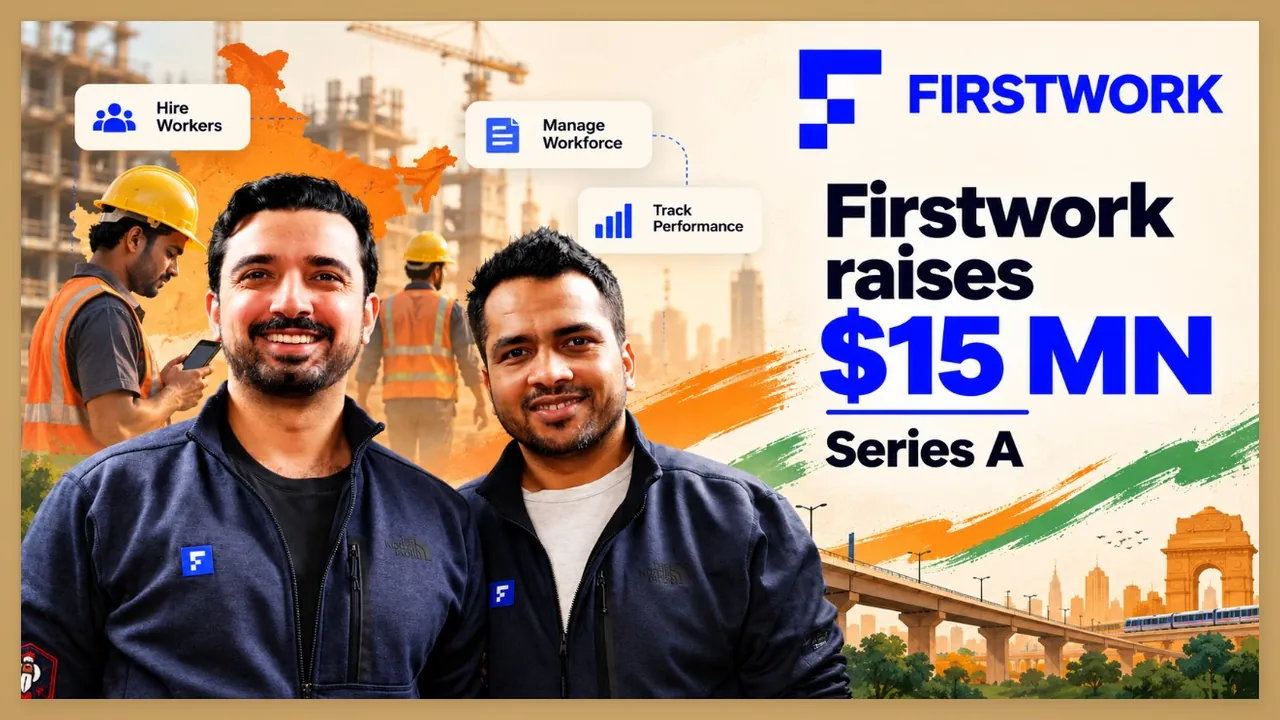
Firstwork, a startup that uses AI agents to get frontline workers cleared and ready for their first shift, has raised $15 million in a Series A round led by Earlybird Venture Capital. Legion VC and Deel Ventures joined as new investors, along with existing backers Gradient and Y Combinator. SOMA Capital, 468 Capital and Houghton Street Ventures also took part.
The round takes Firstwork’s total funding to about $20 million since it was founded in 2024. The company did not disclose its valuation. It raised a $5 million seed round in February 2025 and went through Y Combinator’s Summer 2024 batch, where it pitched itself as “Rippling for seasonal workers”.
Read More: AI Hiring Startup Hunar.AI Raises Rs 39.3 Cr Led By Blume Ventures
Read More: Legal AI Startup Legora Raises $550 Mn At $8.8 Bn Valuation
What Firstwork does
Firstwork works on the stretch between a worker accepting a job and turning up for the first shift. In healthcare, logistics and delivery, that gap is filled with paperwork. Document checks, background verification, training slots and follow-ups all sit between the offer and the first day. Many candidates drop out before they start.
Firstwork’s AI agents handle that work. They contact candidates by text or phone, collect documents, arrange training and chase compliance. The agents run inside an employer’s existing HR, payroll and screening systems. Customers do not have to replace their software stack.
The company said more than 1.5 lakh frontline workers now start work through its platform every month. Customers include Deel, Job&Talent, Relay, Wonolo and BGSF. Firstwork said they have cut the time workers and HR teams spend on each new hire by up to 90%. At one large customer, the platform tripled the number of qualified applicants who reached their first shift.
Why the timing works
Frontline hiring is one of the few large workflows that software never really absorbed. Employers bought applicant tracking systems to record candidates. The chasing, verifying and scheduling still happens on spreadsheets, WhatsApp and phone calls.
“The systems employers rely on were built to record what happened, not to actually do the work,” cofounder and chief executive Vardhan Kapoor said.
Earlybird general partner Tim Rehder made a similar point. He said Firstwork competes for the budget employers spend on people and outsourced teams who do onboarding by hand. He described that as one of the largest untouched opportunities for applied AI in enterprise software.
The Deel signal
Deel, the HR and payroll company valued at $17.3 billion, is both a customer and, through Deel Ventures, now an investor. That matters for more than the cheque. Deel sells employment infrastructure to companies hiring across borders. It already owns the payroll relationship that Firstwork’s onboarding work sits next to.
Chief technology officer Shubham Choudhary was previously director of engineering at Deel. Before that he built core infrastructure for Rippling’s employer of record systems. Kapoor led Asia-Pacific at Remitly and headed strategy at Deliveroo in Singapore, where he recruited frontline workers at volume.
When an investor is also a channel partner, the company’s distribution depends on decisions it does not control. Firstwork’s plan to deepen its presence in the United States and Europe will show how much of its pipeline stands on its own.
The India angle
About 80% of Firstwork’s workforce operates from Bengaluru, and the company has around 45 employees. It is opening a London office to support European customers.
Back home, the category is getting crowded. Hunar.AI raised Rs 39.3 crore in a round led by Blume Ventures, with conversational agents that handle sourcing, screening and onboarding for clients including Swiggy, Delhivery and Flipkart. TurboHire raised $6 million in 2025, while TraqCheck and HireBound work on verification and sourcing.
The demand is structural. NITI Aayog projects India’s gig workforce will grow from about one crore workers in 2024-25 to 2.35 crore by 2029-30. Every one of those workers needs documents verified and training completed before the first shift.
What to watch
Firstwork’s next step is moving beyond onboarding into credential renewals, recurring training and ongoing compliance, the company said. That widens the contract from a one-time clearance to a running workflow.
Three things will show whether the model holds. The share of revenue that comes from repeat work rather than new worker onboarding. Whether the Deel relationship converts into enterprise deals in the US, where the onboarding software market is most competitive. And whether the 90% time saving survives in industries with tighter compliance rules than delivery, such as healthcare.
The larger point is that applied AI has found a workflow where the return is measurable in hours saved per hire.