Soket Labs, ZenteiQ Launch Indigenous AI Models Under IndiaAI Mission

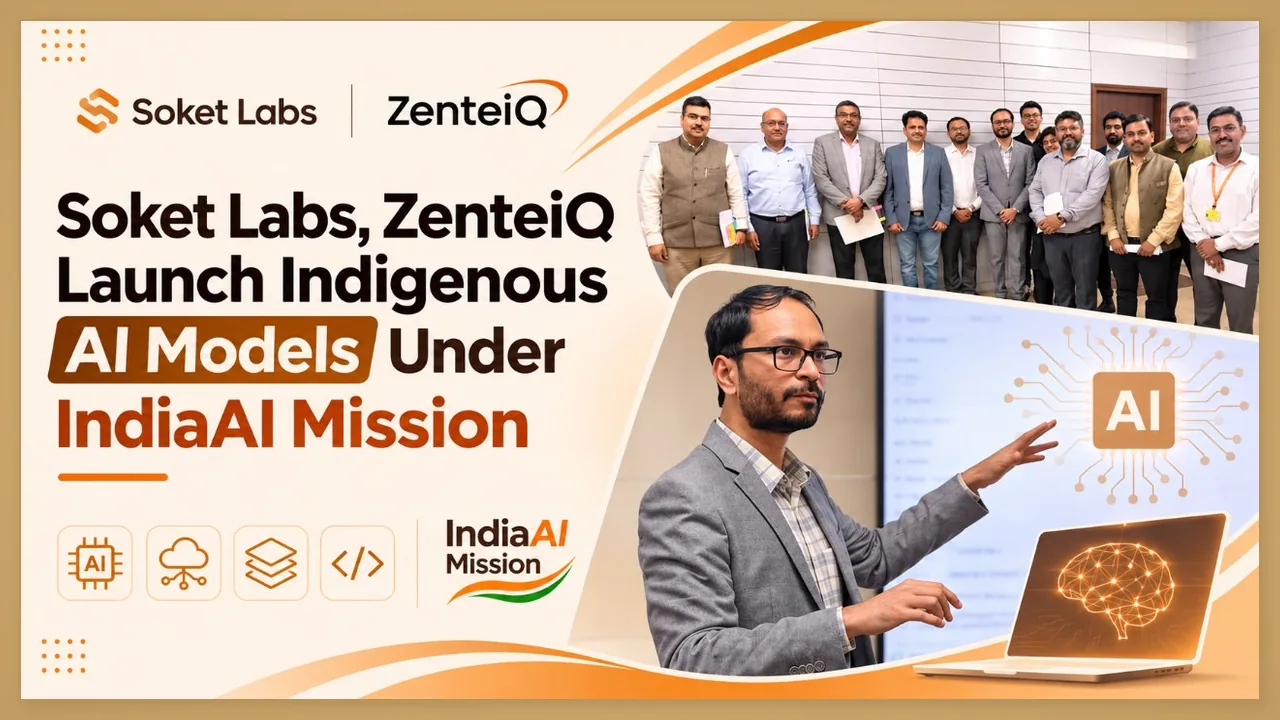
Soket Labs and ZenteiQ have launched indigenous AI models built with support from the IndiaAI Mission, adding two more names to India’s small but growing list of domestic model builders.
Soket’s EKA-1 has 26.3 billion parameters and was trained on nearly 7.5 trillion tokens. It supports 22 Indian languages plus English, and is designed for tasks across mathematics, code and reasoning.
The Soket Model
Soket’s EKA-1 is a large model by Indian standards. Most domestic efforts so far have been in the 2 to 8 billion parameter range, which is useful for narrow tasks but limited on reasoning.
Read More: Razorpay Gets SEBI Nod For Rs 6,000 Cr IPO At $5 Bn Valuation


For Soket Labs, a model at 26 billion parameters with 7.5 trillion training tokens is a different class of build. It implies serious compute, a large clean dataset and a team that knows how to run training without collapse.
Read More: Peppermint Robotics Raises Rs 100 Cr To Scale Industrial Robots
Supporting 22 Indian languages plus English is the harder claim for Soket. Tokenisers built for English fragment Indian scripts badly, and fixing that is a data problem before it is a modelling one.
The ZenteiQ Models
ZenteiQ has taken the smaller, more practical route. Its Dhīr 2B and Dhīr 5B models are open source and multilingual, covering English and 10 Indian languages.
ZenteiQ’s models in that size range can run on a single GPU or even on-device, which makes them usable for enterprises that cannot send data to an American API.
Open-sourcing them is a distribution decision. A model nobody can download does not become a standard. India’s enterprise buyers are more likely to adopt what they can test locally.
Why the IndiaAI Mission Matters
Both launches were announced within days of each other, and that timing is not a coincidence. IndiaAI Mission cohorts tend to ship together, because the compute grants run on shared schedules.
Both companies were selected under the IndiaAI Mission, which provided subsidised compute and research support.
Compute is the binding constraint for Indian model builders. A single serious training run can cost more than a seed round. No domestic venture fund underwrites that line item at pre-Series A.
Subsidised GPU hours change the maths. They let a startup spend its equity on people instead of on cloud bills, which is exactly what a capital-scarce market needs.
The Competitive Picture
The two companies are also chasing different buyers. Soket is aiming at reasoning-heavy work where a bigger model matters. ZenteiQ is aiming at deployment, where a small downloadable model wins.
India’s model landscape now has Sarvam AI, Krutrim and a widening set of smaller builders, alongside global open models that anyone can download for free.
The global models set a brutal price floor. A 26 billion parameter Indian model has to justify itself on language coverage, data residency or cost, not on being generally better.
That is why the enterprise angle matters more for Soket and ZenteiQ than benchmark scores. A bank that must keep customer data inside India will pay for a model it can run on its own servers in its own languages.
What to Watch
Three things will show whether these launches become businesses. The first is published evaluations on Indian language tasks, because a parameter count is not evidence.
The second is inference cost per token. A model that is expensive to serve cannot win enterprise contracts, however good its training run looked.
The third is distribution for Soket Labs and ZenteiQ. Both need partners who embed their models into products, and the count of those partners in six months will say more than the launch coverage.
Sudip Kumar is a Writer at Bharat Fast, contributing to the platform for more than six months. With an interest in startups, entrepreneurship, digital media and graphics designing, he enjoys exploring emerging businesses and sharing informative stories with readers.