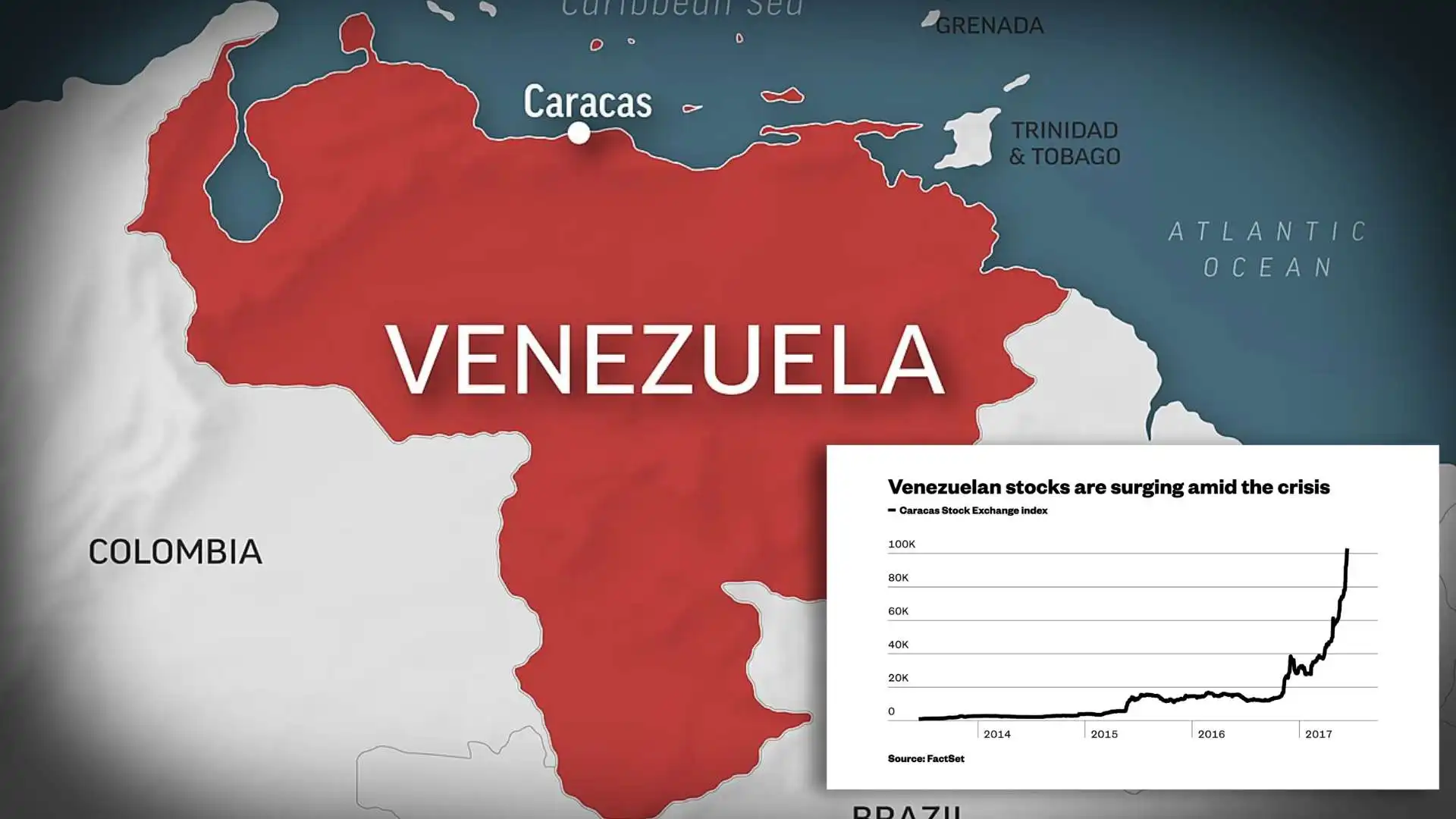
Venezuela’s stock market has stunned global investors after climbing to lifetime highs, marking a dramatic turnaround for an economy long associated with crisis and instability. The sharp rally comes amid significant political developments following the capture of long-time president Nicolás Maduro, a moment that has reshaped investor expectations almost overnight.
The benchmark index on the Caracas Stock Exchange recorded extraordinary gains, including a single-day jump of nearly 50%, pushing the market into the global spotlight. For a country that has battled hyperinflation, sanctions and economic isolation for years, the sudden optimism marks a rare moment of enthusiasm among both domestic and overseas investors.
Political Shock Fuels Market Optimism
Markets are reacting to the belief that Maduro’s removal could signal the start of a political transition. Investors are pricing in the possibility of policy reforms, improved governance and re-engagement with the international community. After years of restricted capital flows and tight sanctions, hopes of a reset have triggered aggressive buying across equities.
The rally reflects how deeply politics and markets are intertwined in smaller and frontier economies. In Venezuela’s case, even the expectation of change has been enough to unlock long-suppressed investor interest.
The $2 Billion Oil Pivot Takes Centre Stage
Central to this renewed optimism is a reported $2 billion oil-related pivot, which has emerged as a major talking point in financial markets. Venezuela holds some of the world’s largest proven crude oil reserves, yet production and exports have remained far below potential due to sanctions and operational challenges.
The new oil reset has revived expectations that Venezuela could gradually reintegrate into global energy supply chains. For investors, oil represents the quickest path to economic stabilisation, given its ability to generate foreign currency, support public finances and attract global capital.
If executed effectively, this pivot could help restore confidence in Venezuela’s battered economy. However, analysts caution that rebuilding oil infrastructure will require sustained investment, technical expertise and political stability.
Small Market, Big Moves
While the headline numbers are impressive, experts warn that Venezuela’s stock market is small and thinly traded, which makes it prone to sharp price swings. Limited liquidity means even modest inflows can trigger outsized rallies, raising the risk of volatility once initial excitement fades.
This makes the recent surge as much a reflection of sentiment as of fundamentals. Long-term gains will depend on whether political clarity emerges and whether economic reforms follow through.
Uncertainty Still Clouds the Outlook
Despite the market euphoria, Venezuela’s future path remains uncertain. Political transitions are rarely smooth, and investors will be watching closely for signals on leadership structure, policy direction and international alignment.
Any delays or reversals in reform momentum could quickly dent confidence. Inflation, currency stability and public finances remain key challenges that will test the credibility of any new economic strategy.
What This Means for Indian and Global Investors
For Indian investors tracking global markets, Venezuela’s rally serves as a reminder of how geopolitical events can trigger sharp market reactions, especially in resource-rich emerging economies. While Indian markets are far more stable and diversified, developments in oil-producing nations can still influence crude prices, inflation trends and global risk sentiment.
In conclusion, Venezuela’s stock market touching lifetime highs reflects a moment of rare optimism built on political change and oil-led expectations. Whether the $2 billion oil reset becomes a true game changer or remains a short-term sentiment booster will depend on what unfolds in the weeks and months ahead.