
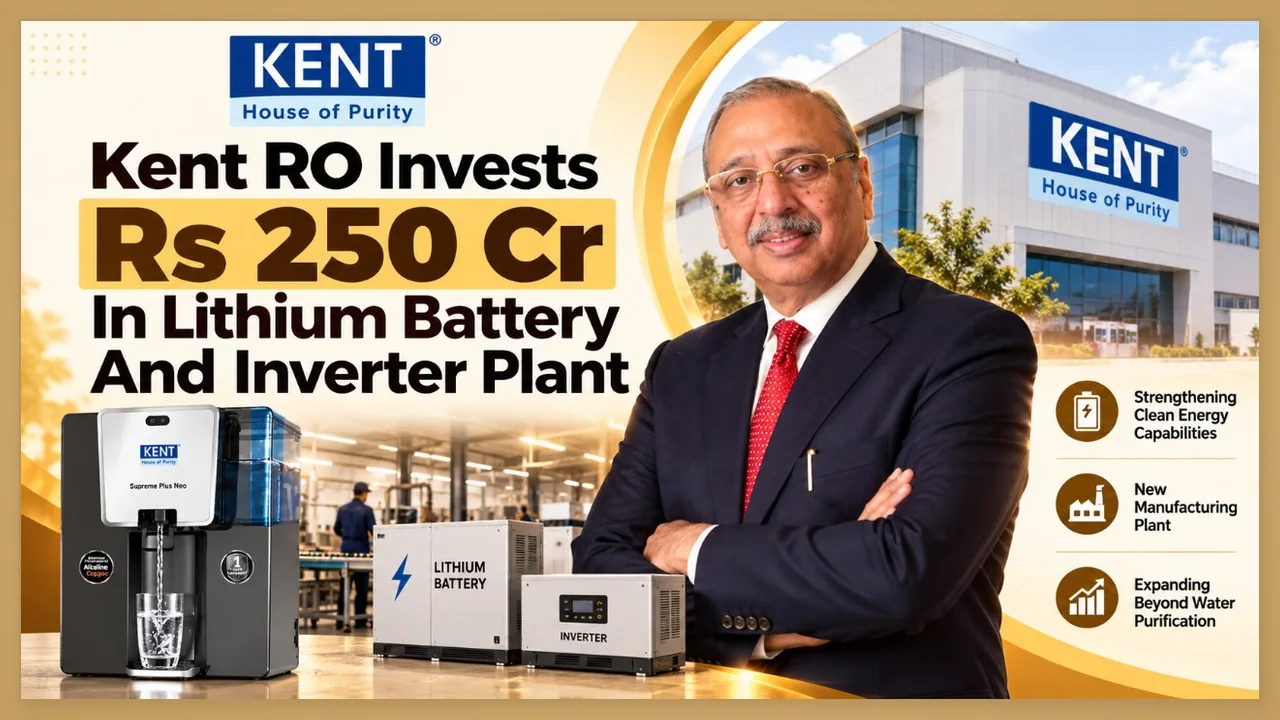
Kent RO Systems has put Rs 250 crore into a lithium battery and inverter plant in Noida. It is the company’s first big move outside water purification. The new division, Kent New Energy, starts with an installed capacity of 3.5 GWh a year. It wants 10 GWh within six months. Kent RO is not building a factory to test the market. It is building one at a scale that assumes demand will be there.
What Kent New Energy Will Make
The range pairs lithium battery packs with solar hybrid inverters. Packs run from 5.1 kWh to 16 kWh and store both solar and grid power for evening use and outages. Kent RO buys cells from EVE and REPT and assembles the packs in Noida. Every hybrid inverter ships with a 4G data logger and a five-year data pack. Installers can see the live status of each unit on the Kent central command app and change settings remotely. The company says data is stored on servers in India, as the Ministry of New and Renewable Energy requires.
Read More: Flipkart Group Posts Rs 1.46 Lakh Crore Revenue In FY26, Loss Narrows
Read More: Kissht Parent OnEMI Gets BSE, NSE Nod For Rs 832 Crore Share Issue
Distribution will ride on the existing Kent RO machine. The batteries and inverters go through the same dealer network, retail stores and online channels that sell its purifiers. Larger packs and solar inverters will additionally move through system integrators and EPC partners.
Why A Water Purifier Company Is Betting On Batteries
India’s inverter battery market is estimated at about $1.31 billion and is expected to grow at double-digit rates until 2031. Lithium-ion packs and hybrid inverters are forecast to grow faster than the lead-acid products that dominate today. That is the opening Kent RO is buying into.
The strategic logic is distribution, not manufacturing. Kent RO already has a dealer base that reaches small towns. It has a service network and a brand that households trust for water appliances. Adding power backup to that shelf costs far less than building a retail channel from scratch. It is the same playbook that took Kent RO from water purifiers into kitchen appliances.
The Import Problem And The Pricing Gap
Mahesh Gupta, chairman and managing director, was direct about the constraint. He said batteries and inverters are still very highly priced, and the cells inside them are still imported. He said product continuity has to be maintained. Raw material supply also has to be secured for the business to scale.
That is the real test. Cells are the largest cost line in a lithium pack, and India does not make them at scale yet. A company that assembles packs without cell control carries price risk on every unit it sells. The 3.5 GWh to 10 GWh jump in six months is more about readying floor space than proof of demand. Kent RO has not said how much of that capacity it expects to use.
What Could Go Wrong
Competition is the obvious one. Exide, Amara Raja and Luminous already own the inverter battery shelf, and several of them are moving into lithium. Dealers have limited display space. A new entrant has to win that space with margin, not just brand recall.
There is a channel risk too. Kent RO’s dealers are trained to sell and service water purifiers and kitchen appliances. Battery and inverter installation needs electrical work and warranty handling. That is closer to the electrical trade than to appliances. Kent RO will have to build that capability. Its five-year data pack suggests it plans to manage the installed base remotely rather than through visits.
Cell prices are the third risk. Lithium prices swing. A high-priced entry product is the first to lose traction when a cheaper alternative appears on the same shelf.
What To Watch
Three numbers matter over the next four quarters. The first is how much of the 10 GWh is actually used, not just installed. The second is the retail price gap between a Kent RO pack and a comparable lead-acid setup. The third is whether Kent RO starts reporting Kent New Energy as a separate revenue line. That would signal the division has become material. Until then, this is a well-distributed bet on a growing category. It is funded by a company whose core business still pays the bills.