

Gym memberships became subject to a lower Goods and Services Tax (GST) rate in September 2025. The headline change was straightforward: the rate dropped from 18% to 5%. However, the revised rate also came with an important condition. Businesses can no longer claim input tax credit under this provision.
For thousands of small gyms and fitness centres across India, understanding the new rate is only part of the challenge. Updating invoice formats, handling part-payments and maintaining accurate tax records have also become important tasks, especially for businesses that still depend on handwritten receipts or spreadsheets.
What Exactly Changed
From 22 September 2025, gym, fitness centre and yoga services became subject to 5% GST without input tax credit. The Central Board of Indirect Taxes and Customs (CBIC) clarified that the earlier option of charging 18% GST with input tax credit is no longer available under the revised treatment. Invoices covered by the earlier rules must be handled according to the applicable time-of-supply provisions.
This transition can create confusion when a membership payment spans the rate-change date. For example, a member may pay part of an annual membership fee in August and the remaining amount in October. The applicable GST treatment may differ depending on when the service was supplied, when the invoice was issued and when payment was received. Gym owners should review such cases carefully rather than automatically applying one rate to the entire membership.
Where Small Gyms Are Getting It Wrong
Many billing errors arise from routine administrative work. Some gyms apply a single GST rate to a membership plan that crosses the transition date. Others continue issuing receipts from printed books that display 18% GST. Some calculate tax incorrectly on part-payments or continue claiming input tax credit without checking whether they remain eligible.
In other cases, payments collected at the reception counter may not be supported by a proper invoice. These gaps can make it difficult to reconcile revenue, prepare tax returns and respond to questions from an accountant.
Such challenges are understandable for smaller fitness businesses. Many gyms are managed directly by their owners, who handle member enquiries, fee collection, trainer schedules and daily operations. There may be no dedicated accountant to review every transaction. Data from Rentech Digital’s business listings indicates that single-owner gyms account for a large share of the sector in Mumbai, highlighting the role of owner-managed businesses in the local fitness market.
Why a Rate History Matters
One practical way to manage a GST rate change is to preserve historical billing records. Previous invoices should retain the tax treatment applicable to their transactions, while new invoices should reflect the revised rules. This makes it easier to review past payments and maintain consistent records.
Managing this process through spreadsheets can be difficult. A change to a formula or tax setting may affect calculations across multiple records if the file is not structured carefully. Manual systems can also make it harder to track part-payments and identify which invoices need review.
Some fitness management platforms now offer tools designed to simplify these tasks. Torzil, an Indian gym management platform founded in 2024, provides custom GST rate settings and rate-history features intended to help gyms maintain consistent billing records. Its GST billing tools include tax breakups, GSTIN details on invoices and GST reports that can support filing preparation.
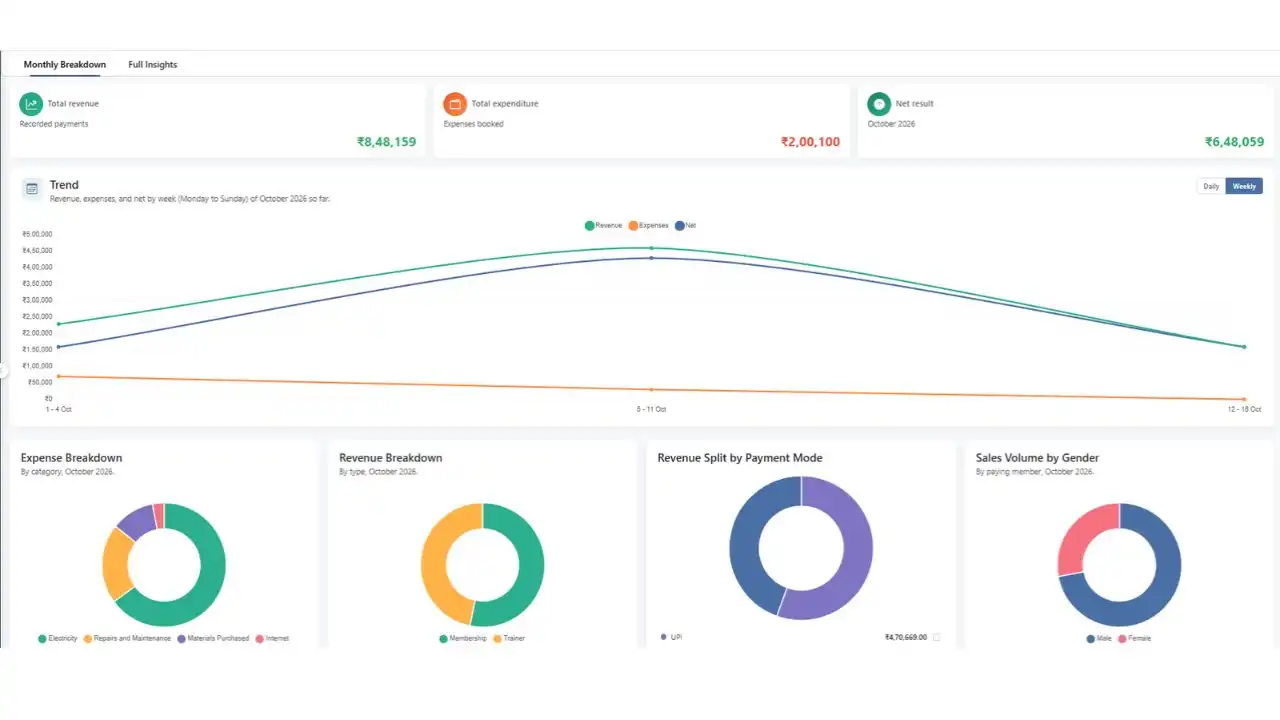
Torzil also provides financial reporting features that bring revenue and expenses together. When payments and tax details are recorded consistently, gym owners can review monthly revenue, expenses and net results in one place. These records can also make it easier to share financial information with an accountant.
A Simple Checklist for Owners
Gym owners can take a few practical steps to improve their billing process. They should update invoice templates and billing software to reflect the applicable 5% GST rate for eligible services. Printed receipt books displaying the old rate should be replaced, and memberships with part-payments or renewals around 22 September 2025 should be reviewed individually.
Owners should also check their input tax credit treatment and avoid claiming credit where it is not permitted under the applicable rules. Maintaining monthly GST reports, recording counter payments and keeping invoices organised can help reduce errors during reconciliation and return preparation.
For transactions that span the rate-change date, businesses should consult a chartered accountant to confirm the correct GST treatment. The applicable tax can depend on the timing of the supply, invoice and payment, so a blanket rule may not be suitable for every membership.
The lower GST rate can reduce the tax charged on eligible gym services. Accurate invoices and organised records are equally important to help businesses manage the transition and avoid preventable compliance problems.
About Torzil
Torzil is a gym and fitness business management platform developed by Torzil Technologies LLP. Founded in India in 2024, the platform is designed for gyms, fitness studios and multi-branch fitness businesses. Its tools include gym management features, GST billing and financial reporting. More information is available at Torzil’s official website, its features page and its gym GST software page.