Towards Safer AI Superintelligence: Vatsal Soin’s Newest 0→1 Invention Patent Filings – Easier Adoption, Ink to Quantum

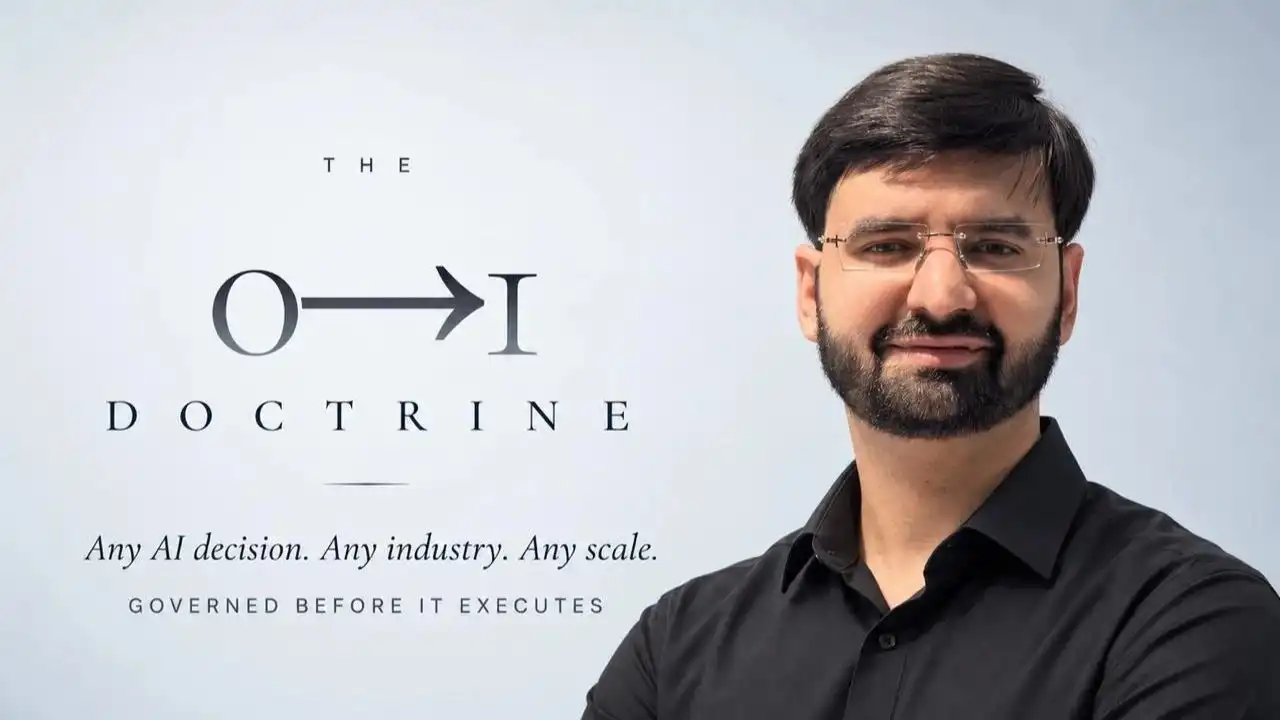
As artificial intelligence continues to expand across industries, ensuring that AI systems operate safely, transparently and responsibly is becoming increasingly important. However, adopting effective AI safeguards often requires organisations to change their existing software, processes and infrastructure. Two newly filed inventions by systems theorist and inventor Vatsal Soin aim to address this challenge through a framework designed to work alongside existing systems.
The two inventions, part of Soin’s 0→1 Doctrine, focus on different aspects of AI safety. One is designed to evaluate and govern AI-driven actions, while the other focuses on organising stored data for safer AI training. Together, they aim to establish a structured approach to AI governance, with applications ranging from traditional paper-based processes to quantum-resilient computing environments.
The platform is available at www.0to1doctrine.com.
TWO INVENTIONS, IN PLAIN WORDS
As AI becomes more involved in decision-making across healthcare, manufacturing, finance and everyday services, the ability to understand why a system takes a particular action is gaining importance.
 Brand PostDevprasad Palani Builds VALIV Projects as a Construction Lead Generation Brand
 Brand PostShekhar Dixit Begins Hunger Strike for Voter Rights in UP
Vatsal Soin’s two patent filings address this requirement through separate but complementary inventions. The 0→1 Doctrine is designed to compare three essential factors: what a user needs, what a supplier or system can provide, and what applicable rules and regulations permit.
It places these factors on a common scale ranging from 0 to 1. Before an AI-driven action takes place, the framework evaluates the available information, generates a decision with supporting reasons and creates a secure record of the process.
The second invention, BBAT (Band-Based Archive Triage), focuses on stored information. It is designed to classify data into grouped ranges or bands based on factors such as age, consent and legal retention requirements.
WHY SAFETY ARRIVES SLOWLY
AI technologies are entering hospitals, warehouses, offices and other workplaces at a rapid pace. However, implementing suitable safety mechanisms can take considerably longer. Organisations often need additional investment, employee training and changes to their existing technology before adopting new governance systems.
This gap is not always caused by a lack of awareness. In many cases, the challenge is the cost and complexity of replacing established infrastructure.
The 0→1 Doctrine takes a different approach. Its design focuses on working alongside existing software and operational processes rather than requiring organisations to replace their systems entirely. This approach could make the adoption of AI governance more practical for organisations with different levels of technological infrastructure.
EASIER ADOPTION, IN PRACTICE
The framework is designed around three different stakeholders: users who express their requirements, suppliers who provide products or services, and regulators who establish operational limits.
For example, a hospital may record a patient’s requirements, a logistics company may specify the capacity of its vehicles, and a government authority may define relevant safety standards.
The Doctrine is designed to bring these inputs onto a common 0-to-1 scale for evaluation. Organisations can connect their existing systems through adapter layers, including support for older software. This is intended to reduce the need for repeated data entry and major operational changes.
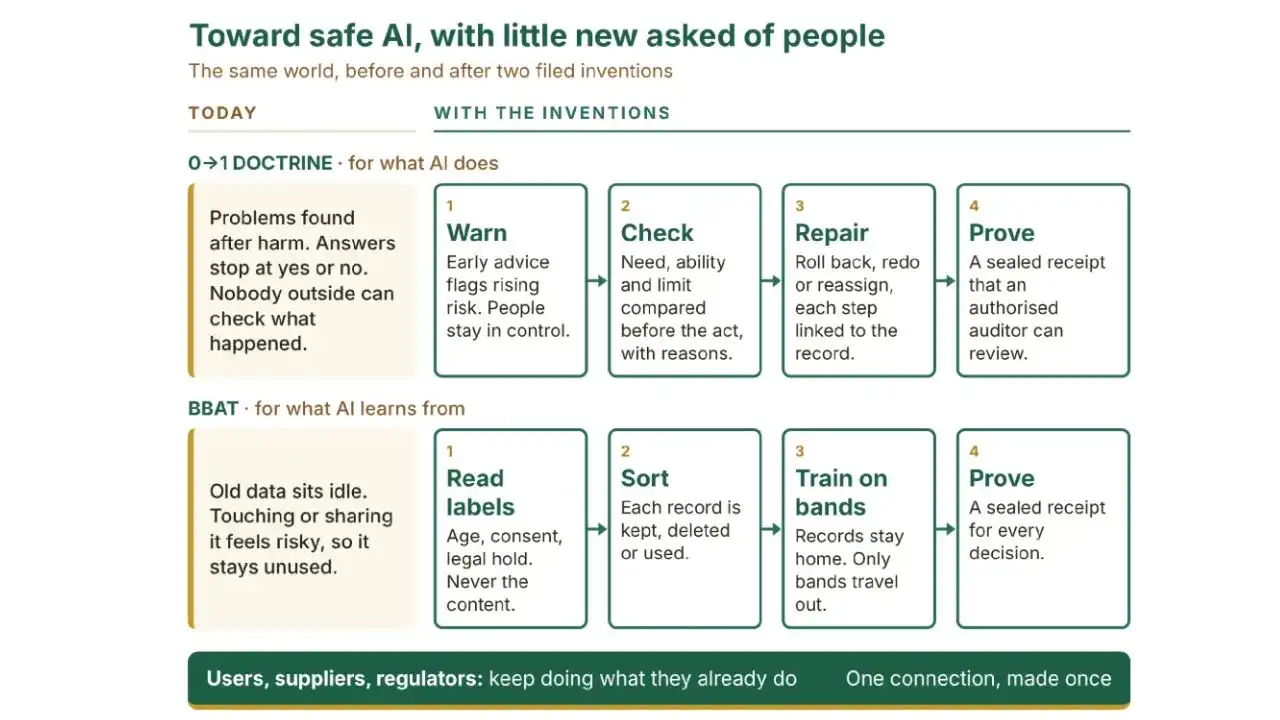
1. WARN EARLY
One of the key components is PRAT, or the Predictive Risk Advisory Token. It is designed to monitor early warning signals, including system drift, equipment wear and changes in supply conditions.
Rather than directly controlling operations, PRAT provides advisory signals. This allows human operators to review potential risks and decide what action should be taken.
For instance, in a freight or cold-storage facility, the system could identify unusual changes in temperature readings before they lead to damage to perishable goods. Early warnings may help organisations investigate problems before they become more serious.
2. CHECK BEFORE THE ACT
The 0→1 Doctrine is also designed to evaluate decisions before an AI system performs an action.
Whether it involves launching a drone, releasing a loan or operating an industrial robot, the framework compares the requested action with available capabilities and applicable limits.
Its decision process is intended to provide more than a simple approval or rejection. Depending on the circumstances, it can recommend approval, additional conditions, redesign, an alternative supplier or refusal with an explanation.
Cases involving uncertainty can be referred to a human reviewer. The authorised person can then approve, modify or stop the proposed action. This approach aims to ensure that important decisions remain subject to human oversight.
3. REPAIR AFTER THE ACT
Preventive checks cannot guarantee that every operational problem will be avoided. The Doctrine therefore includes a proposed mechanism for addressing issues after an action has taken place.
If an error or mismatch is identified, the framework is designed to initiate a corrective process. Depending on the situation, this may involve reversing an action, repeating the work, assigning the task elsewhere or recalculating the original match.
Each corrective step remains linked to the original record, allowing the complete process to be reviewed later.
The system is also designed to identify missing, inconsistent or contradictory information so that potential errors can be addressed before they affect subsequent decisions.
4. PROOF FOR AUTHORISED AUDITORS
Accountability is another important part of the proposed framework. Each governed action is designed to generate an Actuation Compliance Receipt, which records the checks performed and indicates whether any changes were made during the process.
Authorised regulators and auditors can review these records through a dedicated audit interface. The interface is designed to provide relevant proofs and summaries without exposing raw personal information or confidential supplier data.
This creates a record for individual actions while allowing organisations to maintain an audit trail across larger operational networks.
SAFE LEARNING FROM STORED DATA
Apart from governing AI decisions, the second invention focuses on how information is prepared for AI training.
BBAT (Band-Based Archive Triage) is designed to examine stored records using labels such as age, consent status and legal retention requirements. Based on these parameters, it classifies information into appropriate groups.
An important feature of the proposed design is that processing takes place within the data holder’s own secure environment. The original records are intended to remain within that environment.
Instead of transferring individual records, the system is designed to release sealed receipts and derived data bands. These bands represent grouped ranges and can serve as signals for AI training.
The approach aims to support data use while maintaining greater control over sensitive information and its storage conditions.
WHO STAYS IN CHARGE
Human oversight remains central to both inventions.
Within the 0→1 Doctrine, people establish the relevant operating ranges and monitor the system when supervisory intervention is required. The framework is designed to provide recommendations and decision support without removing human authority.
BBAT also includes a Human Override Pathway. It allows an authorised reviewer to resolve uncertain records without directly accessing their underlying content.
This approach aims to maintain accountability while reducing unnecessary exposure to confidential information. The final authority remains with the people and organisations responsible for the relevant decisions.
INK TO QUANTUM
The proposed inventions are designed to support different technological environments, including locations with limited internet connectivity.
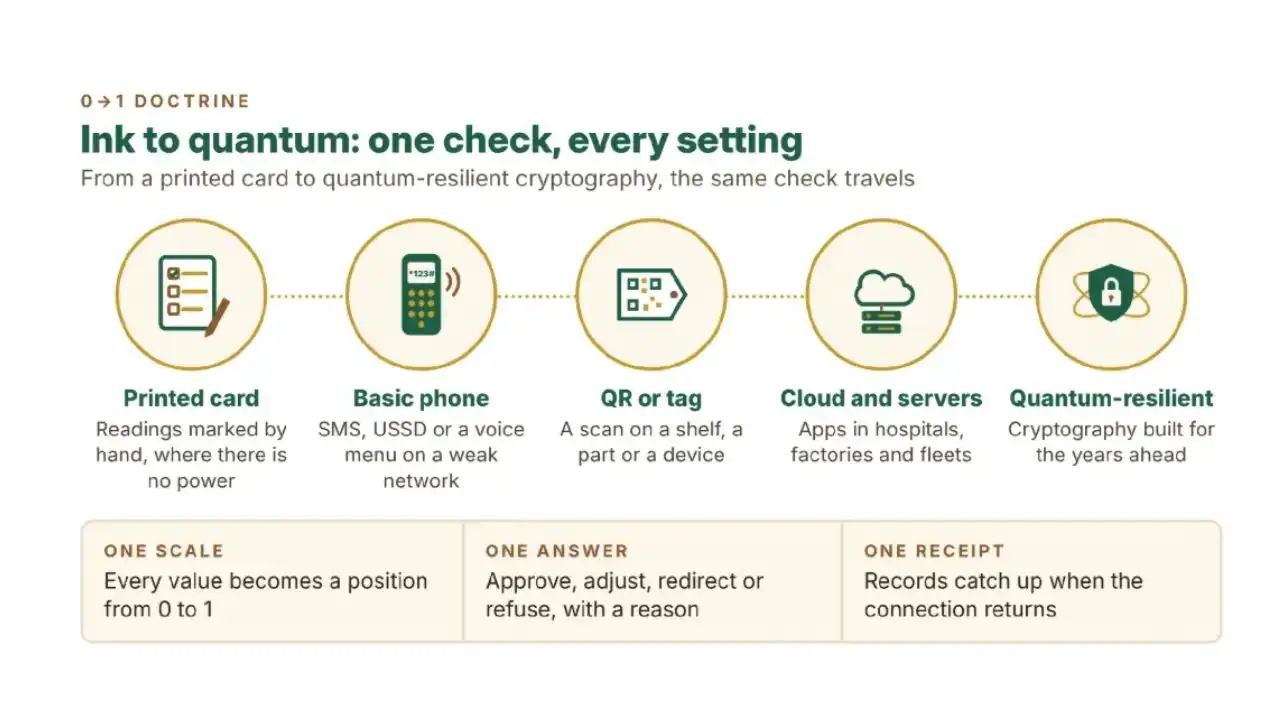
In areas where reliable digital access is unavailable, information and tokens can be exchanged through SMS, USSD, voice menus, QR codes and paper-based forms. The system is designed to reconcile these records when connectivity becomes available again.
At the other end of the technology spectrum, the patent filings also describe applications in quantum-resilient cryptographic environments.
The objective is to maintain a common governance approach across different levels of infrastructure. From a printed card used by a field worker to a cloud-based system operating with advanced cryptographic protection, the same underlying 0-to-1 framework is intended to apply.
AHEAD OF AGI AND SUPERINTELLIGENCE
Artificial General Intelligence (AGI) and superintelligence remain subjects of ongoing research and development. The two patent filings do not claim to deliver either technology.
Instead, they describe governance mechanisms intended to remain relevant as AI capabilities advance. The filings refer to AI, AGI and quantum-resilient environments as part of their broader technological scope.
The underlying objective is to establish mechanisms for decision checks, corrective action and verifiable records before increasingly capable AI systems become more widely deployed.
QUESTIONS ON READERS’ MINDS
Can each invention work independently?
Yes. The 0→1 Doctrine focuses on governing what AI systems do, while BBAT addresses how stored data is organised for AI learning. Both are designed for independent adoption, although they can also work together.
What about conflicting rules between countries?
The Doctrine describes a strictest-rule-prevails approach when regulatory requirements differ across jurisdictions, subject to any applicable recorded override policy. BBAT also considers restrictive data retention requirements when classifying records.
What happens in an emergency?
The Doctrine includes an emergency operating mode designed to prioritise life-critical operations and redirect resources where necessary during disasters or other urgent situations.
Is special hardware needed?
The filings describe compatibility with different computing environments, including conventional processors, AI accelerators, neuromorphic devices, distributed computing nodes and offline-first devices. The proposed approach is not limited to a specialised hardware platform.
Does it suit every industry?
The framework is designed around a common 0-to-1 scale that can be adapted to different sectors. Healthcare, logistics and manufacturing are among the potential application areas. Individual industries can define their own operating ranges without necessarily requiring an entirely new governance system.
How are private details protected?
The proposed privacy architecture includes on-device processing where possible, statistical noise protection mechanisms and cryptographic audit records. These features are intended to reduce unnecessary exposure of sensitive information.
Can the records themselves be trusted?
The Doctrine describes mechanisms for detecting possible tampering or corruption in tokens and logs. It is also designed to support restoration of the last validated state when an issue is identified.
Does it look beyond safety?
Yes. The framework can also incorporate indicators relating to waste, energy consumption and carbon impact. These factors can be represented through 0-to-1 indices and considered alongside operational safety requirements.
CLOSING NOTE
As AI adoption continues to grow, the need for transparent and accountable systems is likely to become increasingly significant. Soin’s two inventions approach this challenge through separate mechanisms for governing AI actions and organising data used for AI learning.
Their proposed scope extends from paper-based processes and limited-connectivity environments to advanced computing and quantum-resilient cryptography.
The platform also provides an opportunity to explore the proposed approach through its live demonstration and API, including a side-by-side comparison of governed and ungoverned processes.
More information is available at www.0to1doctrine.com.
THE INVENTOR
Vatsal Soin is a systems theorist, inventor and serial entrepreneur whose work spans multiple technology and innovation areas. He holds granted patents in the United States, Japan, India and other jurisdictions, with patent filings extending across six continents.
His latest granted patent, relating to AI footwear, was issued in August 2026. His broader invention portfolio includes footwear, apparel fit, Sharable Size Cards, digital twins, robotics, global governed data, archive triage and quantum-resilient cryptography.
An alumnus of SIM–RMIT and NTU, Soin has worked across several areas of technology and product innovation. The 0→1 Doctrine represents his latest effort to bring together AI governance, data management and accountability within a common framework.
SELECTED REFERENCES
Among the granted patents cited in connection with his work are US Patent 12,446,652 B2, Japan Patent 7560909, and Indian Patents 454081 and 599317.
The referenced patent filings include PCT/IN2025/051943, US 19/489,595, India 202511115781, Australia AU2022450649, India 202611113867 (23 September 2026) and PCT/IN2026/052042 (1 October 2026).
DISCLAIMER
This article is intended for informational purposes only. The described inventions and systems are based on patent filings and proposed designs. They should not be interpreted as independently certified technologies or proven field results. No endorsement is implied, and the information does not constitute investment advice.
Krishna Chandra Garain is a serial entrepreneur, Founder of Bharat Fast, India Hood, and Hoodgen AI, with a strong interest in startups, entrepreneurship, technology and digital media. As a business enthusiast, he focuses on building digital platforms and exploring emerging opportunities across the Indian business and technology ecosystem. He is also involved in creating and growing media and technology ventures aimed at delivering information, innovation and business opportunities to a wider audience.
More from this section
Devprasad Palani Builds VALIV Projects as a Construction Lead Generation Brand

Shekhar Dixit Begins Hunger Strike for Voter Rights in UP

Rahul Saraswati Shivkumar’s Book on Tribal Reservation Rights Unveiled in Kannauj