
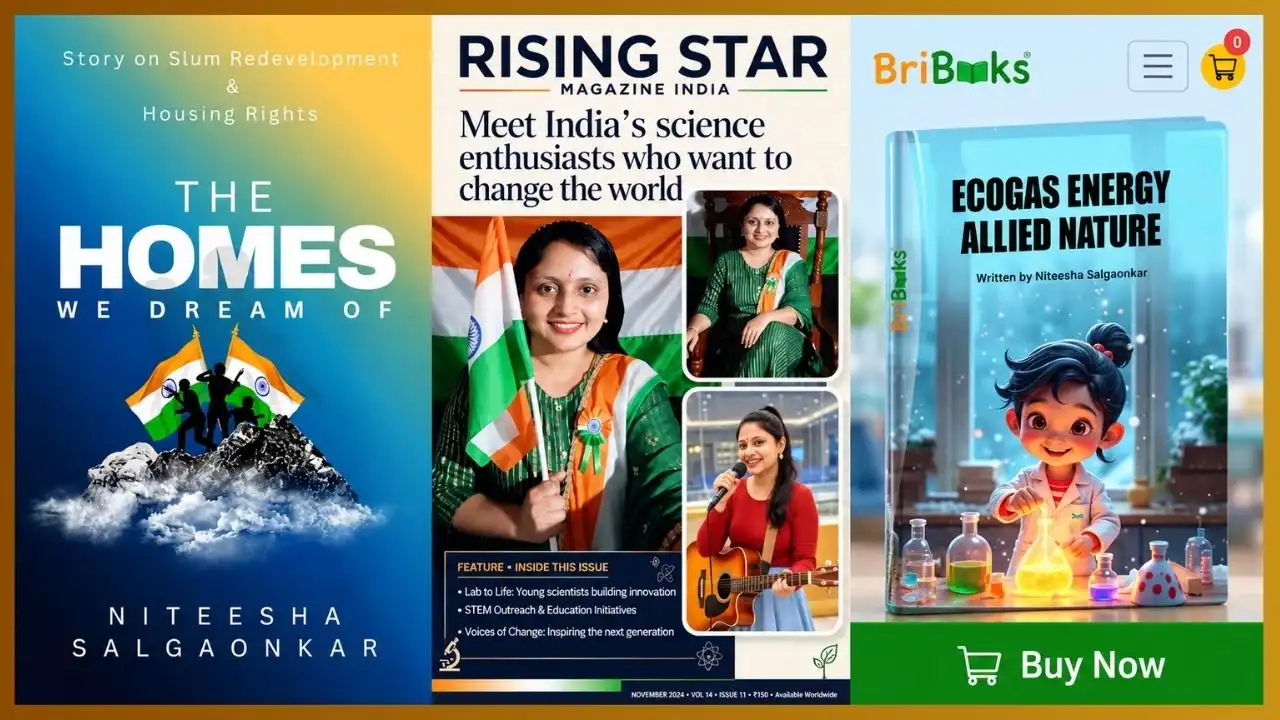
As India explores ways to improve waste management and meet its growing energy needs, author and changemaker Niteesha Salgaonkar presents an idea that connects two important environmental concerns through her book, Ecogas Energy Allied Nature. With the subtitle “Eent Se Energy – Jab Construction Waste Bana Rasoi Ka Hero,” the book examines the possibility of converting construction waste into a resource for alternative cooking fuel.
The concept encourages readers to look at discarded materials differently and consider whether appropriate processing and resource recovery methods could give them a useful second life. By bringing construction waste, energy innovation and environmental responsibility into the same discussion, Salgaonkar invites readers to explore an idea that would require further scientific research and technical validation before practical application.
A Different Perspective on Two Challenges
Construction and demolition waste management and dependence on conventional cooking fuels are two distinct challenges with implications for sustainability. Through Ecogas Energy Allied Nature, Salgaonkar brings these subjects together and asks whether certain construction leftovers could become inputs for a carefully designed waste-to-energy process.
Broken bricks, rubble and other construction materials are often viewed primarily as debris that needs to be removed and disposed of. The book encourages readers to consider whether some of these materials might offer potential for resource recovery through suitable conversion technologies.
However, construction waste cannot simply be treated as household cooking fuel without scientific processing and detailed safety assessments. Its composition, conversion requirements, emissions and potential environmental effects would all need to be examined. The book’s central proposition is therefore best understood as an area for exploration rather than an established fuel solution.
From ‘Eent Se Energy’ to a Research Question
The Hindi subtitle captures the book’s central idea in an accessible way: materials discarded after construction could potentially play a useful role in energy production if a safe and practical conversion method can be developed.
This concept connects waste management with alternative-energy research and encourages readers to move beyond the conventional view of waste as something that must only be discarded. It also raises questions about how resource recovery could contribute to more efficient material use and environmental management.
Turning the idea into a practical application would require considerable technical investigation. Researchers and engineers would need to evaluate suitable processing methods, energy output, emissions, operating costs and safety requirements. Any proposed application would also need to comply with relevant standards and undergo appropriate testing.
By presenting this subject through an accessible book, Salgaonkar opens a discussion that may interest readers examining the future of waste-to-energy technologies under Indian conditions.
A Guide for Students, Engineers and Institutions
Ecogas Energy Allied Nature is positioned for readers interested in practical environmental challenges and emerging energy concepts, including research students, engineers, oil and gas professionals and institutional libraries.
For students, the subject provides an opportunity to explore connections between environmental management, materials processing, waste utilisation and energy innovation. It can also encourage interdisciplinary thinking by bringing together ideas from engineering, sustainability and resource management.
For researchers and technical professionals, the concept raises questions about conversion technologies, commercial feasibility, environmental impact, scalability and the conditions required to move an idea from theory towards practical testing.
Institutional and technical libraries may also find the subject relevant to collections covering sustainability, alternative fuels, waste management and resource recovery. Its value lies in encouraging further inquiry into a concept that would need evidence-based evaluation before it could be considered for wider implementation.
Innovation with a Social Purpose
Alongside her interest in environmental ideas, Niteesha Salgaonkar’s personal journey provides context for her wider work. She has described beginning to teach younger children while still at school to help support her livelihood. She has also spoken about witnessing difficult living conditions, including the struggles of people living in dilapidated homes and army widows, experiences that influenced her interest in social action.
Her professional journey has included work as a former teacher and a CSR activist focused on human and environmental welfare. She has described writing as a way to break silence and singing as a means of stirring emotions, while also expressing an interest in pursuing a professional musical journey.
Her reported honours include Rashtriya Pratishtha Puraskar, Extraordinary Nari, Bharat Ki Veer Beti, Golden Voice and India Karaoke Superstar. She has also contributed as a co-author.
These experiences offer a broader picture of Salgaonkar’s interests across social concerns, creative expression and environmental themes. While the technical concept explored in Ecogas Energy Allied Nature would need independent scientific assessment, its underlying motivation reflects an interest in examining ideas that may address challenges affecting everyday life.
Why the Conversation Matters
The broader significance of Ecogas Energy Allied Nature lies in the question it raises about the potential of discarded construction materials: can they be processed safely and economically to serve a useful role in energy systems?
There is no automatic answer to this question. The feasibility of any such approach would depend on scientific evidence, engineering design, the composition of the waste, environmental performance and economic considerations. Safety would also be essential, particularly if the proposed end use involved cooking fuel.
Nevertheless, exploring the relationship between construction waste and energy recovery can encourage further research and collaboration among engineers, environmental specialists and other technical professionals. It also creates an opportunity to discuss how waste management strategies might evolve through responsible innovation.
The book’s contribution is to bring this possibility into the conversation while leaving room for the research and testing needed to determine whether it can work in practice.
A Book that Encourages Further Exploration
By connecting construction waste with the possibility of alternative cooking fuel, Niteesha Salgaonkar presents a concept that invites readers to question conventional approaches to waste and consider new directions for resource recovery.
Ecogas Energy Allied Nature may interest engineering students, sustainability researchers, technical institutions and readers curious about alternative energy and environmental innovation. Its theme offers a starting point for examining the technical, economic and environmental questions involved in turning discarded materials into potentially useful resources.
Ultimately, the book encourages readers to look beyond the idea of waste as an unwanted by-product and consider how responsible innovation might create new possibilities. Any proposed fuel pathway, however, must be supported by scientific evidence and shown to be safe, practical and environmentally sound before it can be adopted.
Readers interested in Niteesha Salgaonkar’s Ecogas Energy Allied Nature can find the book on BriBooks and Amazon.