
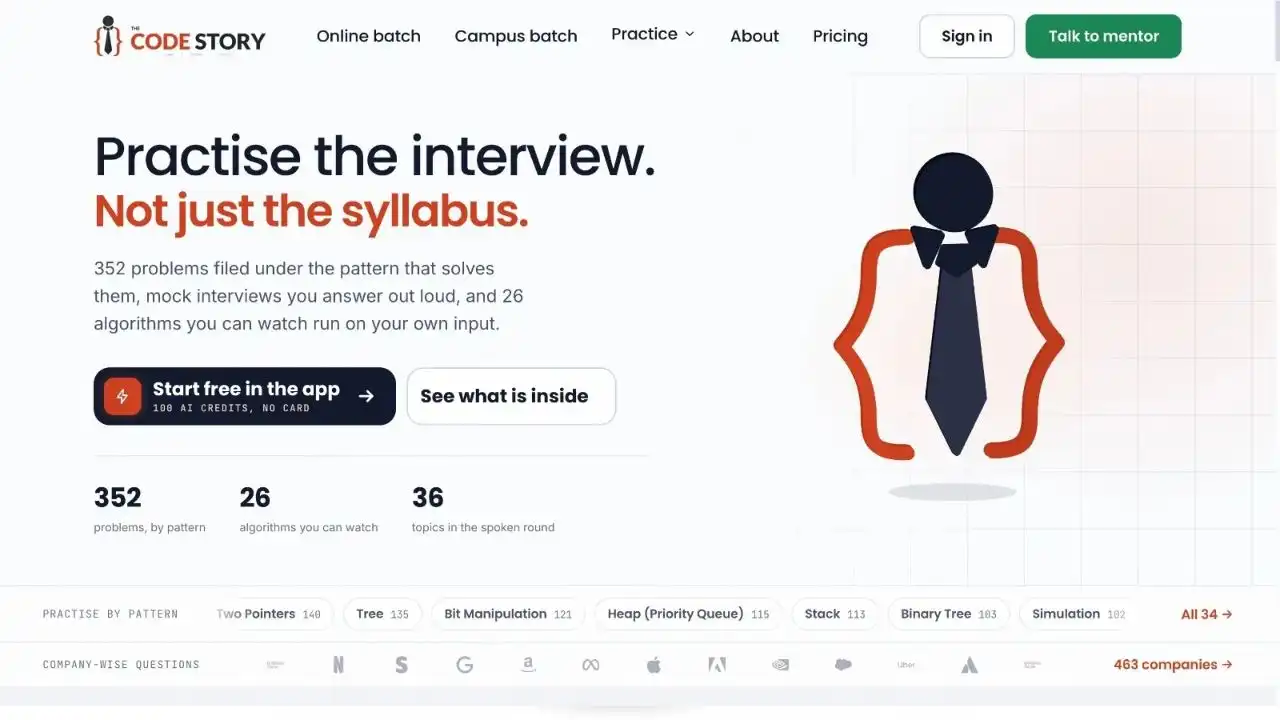
As campus recruitment becomes increasingly focused on practical skills, students need to prepare for several stages of the hiring process. These include coding rounds, aptitude tests, technical interviews and resume screening. CodeStory is a placement preparation platform that brings these activities together in one place, helping students organise their learning and track their preparation.
Founded by Anil Yadav, Founder and CEO, CodeStory brings together tools for data structures and algorithms (DSA), aptitude, SQL, online assessments, mock interviews, resume preparation and career-focused courses. Anuraag Singh is also associated with the platform as a co-founder. Its central dashboard helps learners identify their next steps and organise practice around the companies they want to target.
Company-Wise DSA Practice and Online Judging
For coding interview preparation, CodeStory offers pattern-wise and company-wise DSA practice. Its question sets are mapped to recruitment preparation for 99 companies. Students can practise problems associated with employers such as Google, Amazon, TCS, Infosys and Wipro.
The approach aims to help learners understand recurring problem-solving patterns instead of memorising individual answers. By organising questions around specific companies and coding concepts, CodeStory seeks to provide Indian students with a LeetCode-style practice environment focused on logic building and consistent learning.
The platform also features an online judge that evaluates submitted code against hidden test cases on its servers. It supports multiple programming languages, allowing students to test their solutions under different conditions. This can help learners identify errors and understand whether their code works beyond basic sample inputs.
Practice for Realistic Hiring Assessments
CodeStory includes timed assessments designed around campus recruitment formats associated with companies such as TCS NQT, Infosys, Wipro, Cognizant and Accenture. Students can use these practice sessions to familiarise themselves with common assessment formats and improve their time management.
Alongside campus placement preparation, company-wise coding practice supports students preparing for technical interviews at product-based technology companies such as Google and Amazon. The focus is on helping learners become more comfortable with recruitment tests while improving both accuracy and problem-solving speed.
SQL practice is another part of the platform. Students can run queries against a PostgreSQL database, with submissions evaluated based on the rows returned, including edge cases. CodeStory also offers an algorithm visualiser that demonstrates solution steps using the learner’s own input. This feature can help students understand how an algorithm works rather than simply reviewing the final output.
Interview Simulations That Go Beyond Coding
Technical interviews often assess more than a candidate’s ability to write code. Problem diagnosis, clear communication and the ability to explain decisions can also influence how candidates perform. CodeStory addresses these areas through interview simulation features designed to help students practise different aspects of technical hiring.
One of its highlighted features is an AI debugging round, where learners work on a broken, production-style service with assistance from an AI tool. They must investigate the issue, work towards a fix and explain their approach. The format is intended to combine debugging practice with technical communication.
The platform also offers voice-based theory interviews. These simulations ask spoken follow-up questions based on a learner’s responses. A model answer is included in the resulting report, giving students a reference point for reviewing their understanding. Such practice can help learners become more comfortable explaining technical concepts aloud, particularly when preparing for interviews that require clear and structured answers.
Courses and System Design Learning
Beyond individual practice tools, CodeStory lists structured courses covering DSA, MERN full-stack development, MERN with AI, Java full-stack development and DevOps. These programmes are intended for learners who want to build technical skills through a more organised learning path.
The platform offers online and campus batches, with mentor support described as part of its learning model. This combination of courses and practice tools is designed to help students connect theoretical concepts with practical application as they prepare for technology roles.
For candidates targeting more advanced technical interviews, CodeStory also provides step-by-step system design chapters. The material introduces interview structure and key concepts involved in designing systems that can support large numbers of users. Breaking the subject into smaller sections can make system design easier to approach, particularly for students beginning their preparation for more demanding technical rounds.
A Dashboard for Daily Preparation
Managing placement preparation alongside college coursework can be challenging, especially when students need to practise several subjects at once. CodeStory’s dashboard is designed to make this process more structured by displaying suggested next steps, a short daily plan and progress linked to selected target companies.
The idea is to help students turn a broad placement goal into smaller, manageable tasks. Rather than deciding what to study from scratch each day, learners can use the dashboard to organise their practice and maintain consistency.
CodeStory says its free plan includes lessons, practice exercises and mock interviews. This allows students to explore selected learning and preparation features before considering paid options. Access to a free plan may be useful for learners who want to understand the platform’s approach before making a financial commitment.
CodeStory describes itself as a bootstrapped, student-first platform that aims to keep its published numbers transparent and verifiable. Its combination of coding exercises, assessment practice, interview simulations and structured courses reflects an effort to bring multiple aspects of placement preparation into a single learning environment.
However, using a preparation platform does not guarantee a job offer. Recruitment outcomes depend on several factors, including a student’s existing skills, consistency, interview performance and the specific requirements of an employer. Tools such as CodeStory can support the preparation process, but students still need to practise regularly and develop a strong understanding of the concepts relevant to their chosen roles.
Students and other interested readers can learn more about the people behind the platform through the LinkedIn profiles of Anil Yadav, Founder and CEO, at Anil Yadav on LinkedIn and Anuraag Singh, Co-founder, at Anuraag Singh on LinkedIn. Updates and information about the platform are also available on its official Instagram account.