
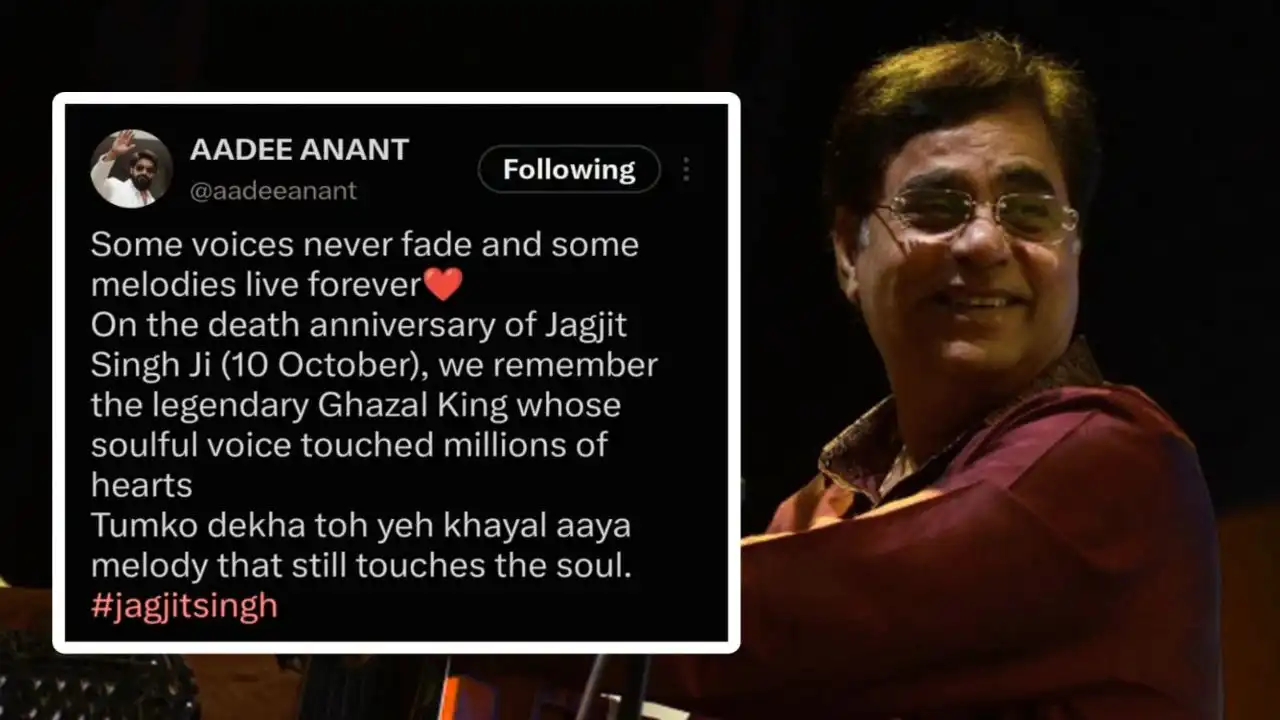
The timeless voice of Jagjit Singh continues to resonate with music lovers across generations. On the legendary ghazal singer’s 15th death anniversary, film director Aadeeanant paid an emotional tribute to the maestro, remembering the music and poetry that have left an enduring mark on Indian music.
Through a heartfelt social media post, Aadeeanant reflected on Jagjit Singh’s extraordinary ability to express love, longing, heartbreak and hope through his distinctive voice. For the filmmaker, the singer’s legacy extends beyond memorable melodies, representing a rare connection between poetry and human emotion.
Among the compositions that hold a special place in Aadeeanant’s heart is Aah Ko Chahiye Ek Umar Asar Hone Tak, based on the poetry of legendary Urdu poet Mirza Ghalib. The ghazal captures the depth of unfulfilled longing and the passage of time, with Jagjit Singh’s expressive rendition bringing an enduring emotional quality to Ghalib’s words.
Aadeeanant’s Favourite Jagjit Singh Ghazals
For Aadeeanant, revisiting Jagjit Singh’s music is an experience that goes beyond nostalgia. Each composition offers a different perspective on life, relationships and human emotions, making it difficult to choose just a handful of favourites from the singer’s extensive repertoire.
One such favourite is Kal Chaudvin Ki Raat Thi, a ghazal celebrated for its romantic imagery and poetic elegance. Its evocative verses and Jagjit Singh’s understated delivery create an intimate atmosphere, allowing the poetry to take centre stage.
Another composition that resonates with the filmmaker is Har Taraf Har Jagah Beshumar Aadmi. Moving beyond conventional romantic themes, the song reflects on human existence and the complexities of life. It also highlights the broader emotional and philosophical dimensions of Jagjit Singh’s musical repertoire.
Aadeeanant also holds a special affection for Tumko Dekha Toh Ye Khayal Aaya, the much-loved song from the 1982 Hindi film Saath Saath. Sung by Jagjit Singh and Chitra Singh, the romantic composition remains cherished for its gentle melody, evocative lyrics and understated arrangement.
The song’s lasting popularity reflects one of Jagjit Singh’s greatest strengths: his ability to communicate profound feelings without relying on elaborate musical arrangements. His voice brought an intimacy to the composition that continues to connect with listeners decades after its release.
A Heartfelt Social Media Tribute to Jagjit Singh
Aadeeanant’s admiration for the legendary singer found expression in an emotional message shared on social media on October 10, marking Jagjit Singh’s death anniversary.
“Some voices never fade, some melodies never die…” the filmmaker wrote, capturing the enduring influence of a singer whose music continues to accompany countless personal memories.
Reflecting on the emotional significance of Jagjit Singh’s songs, Aadeeanant acknowledged how his ghazals have helped listeners express feelings that are often difficult to put into words. He also recalled the magic of Tumko Dekha Toh Ye Khayal Aaya, a composition that continues to hold a special place in the hearts of romantic music enthusiasts.
“Your voice lives on in every note, every memory, and every tear,” Aadeeanant wrote, concluding his tribute with the heartfelt words, “Forever in our hearts, Jagjit Singh.”
The message reflects the lasting bond between Jagjit Singh’s music and the people who continue to discover meaning in his songs. For admirers such as Aadeeanant, revisiting these compositions is not simply an act of remembering a celebrated artist; it is also a way of reconnecting with the emotions his music evokes.
How Jagjit Singh Changed the Ghazal Landscape
Born on February 8, 1941, Jagjit Singh became one of India’s most influential ghazal singers, helping bring the genre to a wider audience through his accessible musical style and expressive voice.
Traditionally associated with Urdu poetry and classical musical traditions, ghazals found a broader audience through his approach, which combined the literary richness of the verses with contemporary arrangements and memorable melodies. His music made the genre more approachable without losing its emotional depth.
His contribution extended beyond his vocal performances. Through his interpretations of poetry, Jagjit Singh demonstrated how music could communicate complex emotions with remarkable simplicity. Themes of love, separation, loneliness and reflection became accessible to listeners from different backgrounds, helping his compositions transcend linguistic and generational boundaries.
His musical partnership with Chitra Singh also produced memorable compositions that remain part of India’s musical heritage. Together, they helped shape the sound and popular appeal of modern ghazal music.
Jagjit Singh passed away on October 10, 2011, at the age of 70. More than a decade later, his recordings continue to attract listeners who find comfort, nostalgia and emotional resonance in his work.
A Legacy That Continues to Live Through Music
Fifteen years after his passing, Jagjit Singh’s music remains deeply embedded in India’s cultural memory. His ghazals continue to accompany moments of love, heartbreak, solitude and quiet reflection, offering listeners a sense of connection that few artists can create.
For Aadeeanant, the singer’s enduring appeal lies in the emotional honesty of his voice and the timeless quality of the poetry he brought to life. Whether through the longing expressed in Aah Ko Chahiye Ek Umar Asar Hone Tak or the romance of Tumko Dekha Toh Ye Khayal Aaya, each composition offers a distinct emotional experience.
The filmmaker’s tribute serves as a reminder that the influence of a great artist cannot be measured by time alone. Jagjit Singh may no longer be present, but his voice continues to reach new generations, preserving the beauty of ghazals and reaffirming music’s remarkable ability to connect people through shared emotions.