Falcon Skyworks Advances Indigenous Aerospace Innovation Under Aashish Prithwi Raj


BENGALURU, INDIA: What started as a small home-based engineering workspace in 2025 has gradually developed into an aerospace and defence technology venture. Founded by engineer Aashish Prithwi Raj, Falcon Skyworks Inc. is working across unmanned aerial systems (UAVs), drone communication, specialised electronics, propulsion and aerospace research.
Based in Bengaluru, the company aims to contribute to India’s growing focus on indigenous technologies and domestic capabilities in strategic sectors. Its journey began with customised First-Person View (FPV) drones before expanding into communication systems and specialised aerospace engineering.
An Early Supply Milestone
One of the company’s early milestones came through the supply of seven high-speed FPV drones shortly before Operation Sindoor began, according to founder Aashish Prithwi Raj. Falcon Skyworks considers this an important step in its early development and a foundation for its subsequent focus on indigenous drone communication technologies.
The experience also encouraged the company to look beyond customised drone manufacturing. Its attention gradually shifted towards developing the technologies that enable unmanned platforms to communicate, operate and remain connected. This marked an important change in its engineering roadmap.
 Brand PostFalcon Skyworks Reports Mach 4.5 Milestone in KAANTHAM v1 Aerospace Programme
 Brand PostFalcon Skyworks Reports Mach 4.5 Internal Trials for KAANTHAM v1, Targets February 2027 Te…
FS01 ALFA: Indigenous Drone Communication
In July 2025, Falcon Skyworks introduced FS01 ALFA, an indigenously developed drone transmitter. The company describes the product as India’s first indigenous drone transmitter, a distinction that remains subject to independent industry verification.
According to the company, the development involved multiple firmware revisions, hardware integration and field testing. The project reflects its broader objective of building drone communication technologies within India rather than depending entirely on imported solutions.
Following FS01 ALFA, the company identified long-range communication modules, telemetry solutions and UAV control systems as important areas for further development. These technologies form part of its wider efforts to strengthen indigenous capabilities in unmanned aerial systems.
Aashish Prithwi Raj: Engineering Background
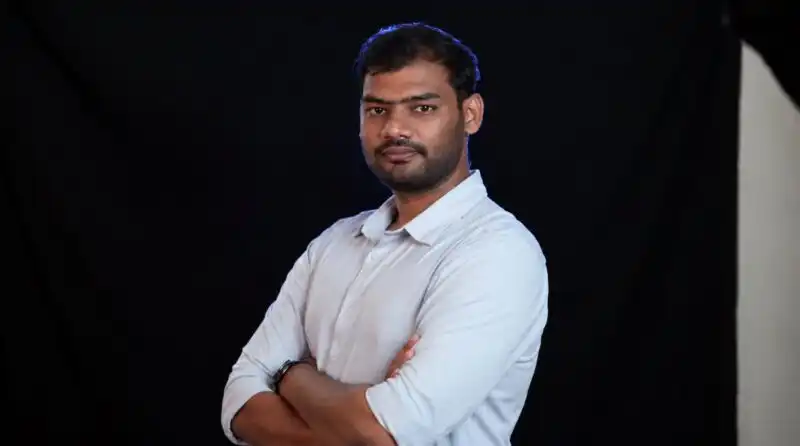
Aashish Prithwi Raj, Founder and CEO of Falcon Skyworks Inc., brings an academic and professional background spanning mechanical engineering, cybersecurity research and aerospace-related firmware development.
He studied Mechanical Engineering at the Indian Institute of Technology (Banaras Hindu University), Varanasi, between 2016 and 2020. He later pursued research master’s studies in cybersecurity at Middlesex University, London.
In 2022, Aashish worked as a Firmware Designer on a project associated with the Su-30 aircraft production programme. His exposure to engineering and firmware development helped shape his interest in indigenous aerospace technologies.
He subsequently established Falcon Skyworks with a focus on original engineering, domestic intellectual property and the development of specialised technologies for India’s aerospace and defence ecosystem.
Expanding Across Aerospace and Defence
Falcon Skyworks is gradually broadening its engineering activities across multiple technology areas. Its stated focus includes UAV transmitters, ground-control systems, long-range communication, telemetry, FPV drones, propulsion, avionics, embedded firmware and defence electronics.
The company is also exploring autonomous aerial platforms and intelligent navigation technologies. Its engineering activities reportedly extend across Bengaluru and Hyderabad, supported by remote research collaborations.
Its development approach brings together radio-frequency engineering, electronics, software development, propulsion, mechanical design and UAV system integration. Falcon Skyworks has also participated in technical exhibitions, workshops and institutional engagements related to indigenous aerospace innovation.
KAANTHAM v1 and the Next Phase
Beyond unmanned aerial systems, Falcon Skyworks is pursuing a wider aerospace research roadmap. One of its announced programmes is KAANTHAM v1, which the company describes as a lightweight, high-speed missile research initiative.
According to Falcon Skyworks, the programme has progressed through primary research, development and design simulations, while field testing remains ongoing. The company has set February 2027 as its target for the official launch and formal testing.
The programme carries a stated performance objective of Mach 4.5. However, this remains a development target and is subject to technical evaluation and final field validation. Its actual performance and capabilities have not yet been independently established.
The initiative represents an ambitious expansion of the company’s research activities. Its future progress will depend on technical validation, reliability, regulatory compliance and documented testing outcomes.
A Long-Term Indigenous Technology Vision
Falcon Skyworks aims to establish itself as an engineering-driven contributor to India’s aerospace and defence technology ecosystem. The company’s approach centres on indigenous development, specialised research and building technologies with long-term applications.
Sharing his vision, Aashish Prithwi Raj says, “I do not dream of building a company that merely competes with the world. I dream of building technologies that make the world recognise what Indian engineers are capable of.”
From an early home workshop to developing drone transmitters, communication systems and broader aerospace research programmes, Falcon Skyworks has outlined an ambitious growth journey. The next stage will depend on converting its research initiatives into technically validated products, reliable manufacturing capabilities and wider industry adoption.
Mayank Jain is a writer at Bharat Fast (bharatfast.com), covering startups, funding rounds and business.
More from this section
Rajdeep Sharma: A Journalism Career Across Print Media and Digital News

5 Top Naturopathy Speakers in India and 5 Best Naturopathy Centres for Natural Wellness

MalikTimes Publishes Daily Gold and Silver Rates, City by City, as Festive Buying Begins